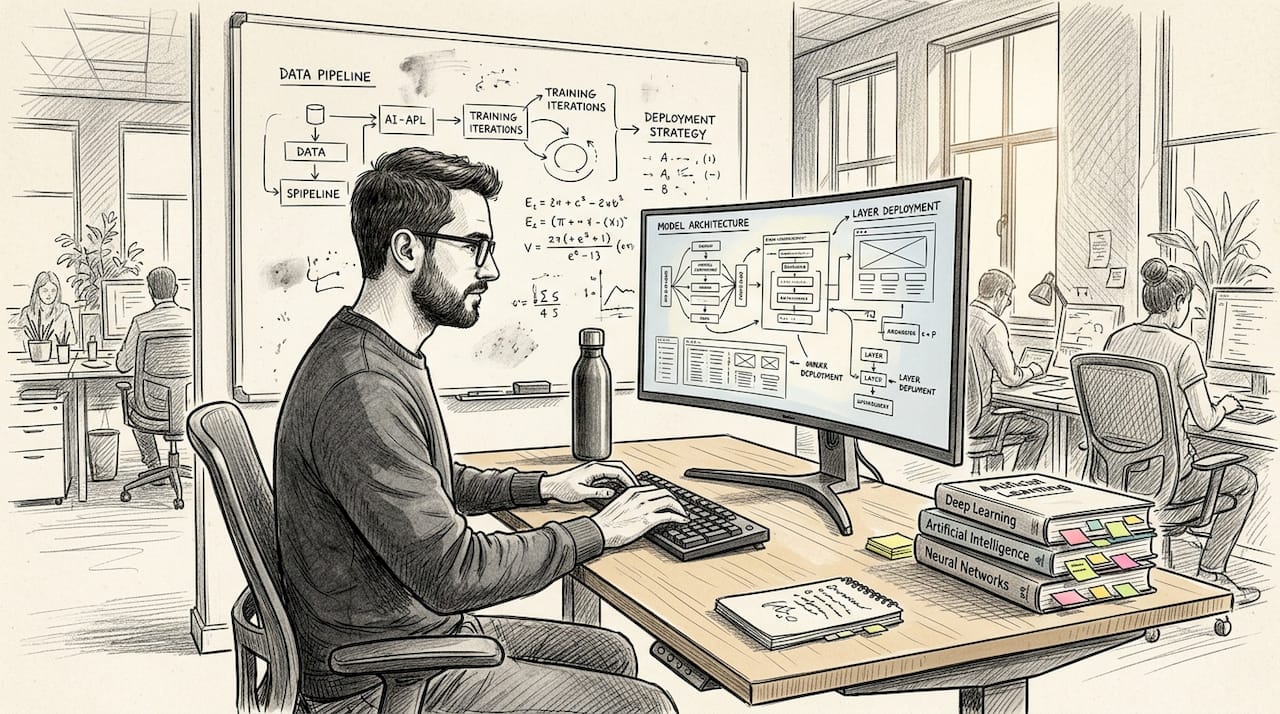
AI Architecture Explained Practical Guide for AI Engineers
AI Architecture Explained Practical Guide for AI Engineers
Building AI systems is not just about training models. Most software engineers transitioning into AI roles quickly realize that neural networks are only one piece of a much larger puzzle. Production AI systems require understanding data pipelines, inference engines, orchestration layers, and monitoring infrastructure. This guide breaks down the essential components of AI architecture, from the six-layer system design to neural network evolution, benchmarking trade-offs, and the critical role of governance. You’ll gain practical knowledge to architect reliable AI systems that actually ship.
Table of Contents
- Key takeaways
- Understanding the six layers of production AI architecture
- Neural network architectures: evolution and mechanics
- Benchmarking AI models: evaluating performance and trade-offs
- Orchestration, monitoring, and governance in AI architecture
- FAQ
Key Takeaways
| Point | Details |
|---|---|
| Six layer AI architecture | Production AI relies on six interconnected layers from data to monitoring, not just the model. |
| Monitoring and governance | Ongoing monitoring detects drift, biases, and policy violations to keep systems reliable. |
| Data lineage matters | Robust data provenance and version control are foundational to trustworthy predictions. |
| From FCN to transformers | Neural architectures evolved from fully connected networks to transformers to handle complex data. |
| Benchmark tradeoffs | Benchmarks reveal how model accuracy may trade off with latency cost and reliability in production. |
Understanding the six layers of production AI architecture
Most engineers assume AI architecture means picking a model and training it. That’s like saying web development is just writing HTML. Real production AI systems involve six interconnected layers, each with distinct engineering challenges.
The Data layer handles ingestion, storage, preprocessing, and feature engineering. Common failure modes include poor data provenance, quality issues, and version control gaps. You need robust pipelines that track lineage and validate inputs continuously. Without this foundation, models train on garbage and produce unreliable outputs.
The Model layer contains your neural networks and algorithms. This is where you select architectures, configure hyperparameters, and manage model versions. Overfitting, underfitting, and poor generalization plague this layer. Engineers often fixate here while neglecting the surrounding infrastructure.
Training Infrastructure provides the compute and orchestration for model development. This includes distributed training frameworks, experiment tracking, and resource management. Bottlenecks emerge from inefficient data loading, suboptimal parallelization, and inadequate logging. Scaling training requires understanding hardware utilization and cost optimization.
The Inference Engine serves predictions in production. Latency, throughput, and resource consumption matter more here than training accuracy. You’ll work with model serving frameworks, batching strategies, and caching mechanisms. Many models that perform well in training fail here due to size or computational requirements.
Integration/API layers connect AI systems to applications and users. This is pure software engineering: RESTful APIs, message queues, authentication, rate limiting. Engineers transitioning from traditional software development excel here, but must adapt to AI-specific concerns like prompt management and context handling.
Monitoring/Governance tracks system health and ensures compliance. You’ll measure prediction accuracy, detect drift, audit for bias, and enforce data policies. Most AI systems fail not because models are bad, but because no one monitors degradation over time. This layer separates hobby projects from production systems.
Pro Tip: Start with monitoring infrastructure before deploying your first model. Instrument everything from data quality metrics to prediction latency. You can’t fix what you can’t measure, and AI systems degrade silently without proper observability.
Each layer requires different skills. Data engineers focus on pipelines. ML engineers optimize models. Infrastructure engineers handle scaling. Software engineers build APIs. DevOps engineers manage deployment. Understanding how these layers interact makes you a more effective AI architect.
Neural network architectures: evolution and mechanics
Neural network architectures evolved to handle increasingly complex data patterns. Understanding this progression helps you choose the right model for your task and recognize when to combine multiple approaches.
-
Fully connected networks (FCN) connect every neuron in one layer to every neuron in the next. They work for simple tabular data but scale poorly. With thousands of features, parameter counts explode and training becomes impractical. They also ignore spatial and temporal relationships in data.
-
Convolutional neural networks (CNN) introduced local connectivity and weight sharing through convolutional filters. These networks excel at image processing because they detect features like edges and textures regardless of position. Pooling layers reduce dimensionality while preserving important patterns.
-
Recurrent neural networks (RNN) and Long Short-Term Memory (LSTM) networks process sequential data by maintaining hidden states. They handle variable-length inputs and capture temporal dependencies. However, they struggle with long sequences due to vanishing gradients and slow sequential processing.
-
Transformers replaced recurrence with attention mechanisms, allowing parallel processing of entire sequences. Self-attention computes relationships between all positions simultaneously. This architecture powers modern language models and increasingly handles vision tasks through Vision Transformers.
Key mechanics underpin all architectures. Feature extraction occurs in early layers, detecting simple patterns that combine into complex representations. Non-linear activation functions like ReLU enable networks to model complex relationships. Backpropagation computes gradients efficiently, allowing optimization through gradient descent.
Efficiency improvements matter for production deployment. Depthwise separable convolutions reduce parameters while maintaining accuracy. Quantization shrinks model size by using lower precision numbers. Pruning removes unnecessary connections. These techniques make models faster and cheaper to serve.
Hybrid models combine strengths of multiple architectures. ConvNeXt modernizes CNNs with transformer-inspired designs. Vision-Language models merge CNN feature extraction with transformer reasoning. The trend is toward flexible architectures that adapt to diverse data types rather than specialized networks for each domain.
Pro Tip: Don’t chase the newest architecture without understanding your requirements. CNNs still outperform transformers on many vision tasks with less compute. RNNs work fine for short sequences. Match architecture complexity to problem complexity, not research hype.
Benchmarking AI models: evaluating performance and trade-offs
Benchmarks reveal how models perform on standardized tasks, exposing trade-offs between accuracy, speed, and specialization. Understanding these metrics guides architectural decisions and prevents costly mistakes.
Segmentation model benchmarks show performance variations across architectures:
| Model | Dice score | IoU | Parameters |
|---|---|---|---|
| U-Net | 0.89 | 0.82 | 31M |
| U-Net++ | 0.91 | 0.84 | 36M |
| Attention U-Net | 0.90 | 0.83 | 34M |
U-Net++ achieves higher accuracy but requires more parameters. Attention U-Net balances performance and efficiency. Your choice depends on whether you optimize for accuracy or inference speed.
Language model benchmarks test different capabilities:
- SWE-Bench measures code generation and debugging on real GitHub issues. Top models score around 30%, revealing how far we are from fully autonomous coding.
- GPQA evaluates graduate-level reasoning across physics, chemistry, and biology. Scores near 50% show strong domain knowledge but imperfect reasoning.
- ARC-AGI-2 tests abstract reasoning and pattern recognition. Low scores across all models highlight gaps in general intelligence.
These benchmarks expose specialization trade-offs. Models optimized for code struggle with scientific reasoning. Domain-specific fine-tuning improves targeted performance but reduces generalization. You can’t have a model that excels at everything while remaining efficient.
Reliability matters more than peak accuracy. A model that scores 95% on average but fails catastrophically 5% of the time is worse than one that consistently delivers 90%. Benchmarks rarely capture worst-case behavior or edge cases that break production systems.
Monitoring bridges the gap between benchmark performance and production reality. Models degrade as data distributions shift. User behavior changes. New edge cases emerge. Continuous evaluation on production data reveals issues that static benchmarks miss.
Pro Tip: Create custom benchmarks that mirror your actual use cases. Public benchmarks guide initial selection, but real-world performance depends on your specific data distribution, latency requirements, and error tolerance. Measure what matters to your users.
Orchestration, monitoring, and governance in AI architecture
The model layer offers under 10% reliability without proper orchestration and monitoring. This reality separates toy demos from production systems. Software engineers transitioning to AI must master these layers to build systems that actually work.
Orchestration acts as the harness around AI models, handling errors, routing requests, and managing fallbacks. When a model fails, orchestration catches the error and triggers alternative paths. When latency spikes, it routes to faster models. When accuracy matters most, it routes to larger models despite cost.
Tiered model architectures balance performance and cost. Route simple queries to small, fast models. Send complex requests to larger models. Use cascading logic where a small model attempts the task first, escalating to larger models only when confidence is low. This approach reduces latency and compute costs while maintaining quality.
Error handling in AI differs from traditional software. Models produce wrong answers confidently. They hallucinate facts. They misunderstand context. Your error handling patterns must detect these failures through confidence thresholds, validation checks, and human review triggers.
Monitoring tracks critical metrics across the system:
- Prediction accuracy on production data versus training benchmarks
- Latency percentiles to catch performance degradation
- Input distribution drift signaling data changes
- Bias metrics across demographic groups
- Error rates and failure modes by request type
Drift detection identifies when model performance degrades. Compare current predictions against labeled ground truth. Track feature distributions over time. Alert when metrics cross thresholds. Retrain or roll back before users notice quality drops.
Governance ensures compliance and trust. Audit model decisions for fairness. Track data lineage to verify training sources. Enforce access controls on sensitive predictions. Document model behavior for regulatory requirements. These practices matter more as AI systems handle high-stakes decisions.
“The missing layer in AI systems is not better models, but better monitoring and governance. Models will always have limitations. The question is whether you detect and handle failures gracefully or let them cascade into user-facing disasters.”
Production AI monitoring requires dedicated infrastructure. Logging frameworks capture predictions and inputs. Dashboards visualize trends. Alerting systems notify engineers of anomalies. Feedback loops collect user corrections to improve future versions.
Pro Tip: Implement shadow mode before full deployment. Run your new model alongside the existing system, logging predictions without serving them to users. Compare outputs to identify regressions and edge cases. This approach catches issues before they impact production traffic.
FAQ
What are the main challenges when transitioning from software engineering to AI architecture?
The biggest challenge is understanding that AI systems require different reliability patterns than traditional software. Deterministic code either works or throws clear errors. AI models fail silently, producing plausible but wrong outputs. You must design for probabilistic behavior, implementing validation, monitoring, and fallback strategies that traditional software rarely needs.
How does AI monitoring improve system reliability?
Monitoring detects drift, bias, and accuracy degradation before users notice quality drops. By tracking prediction distributions, error rates, and performance metrics continuously, you identify issues early. This allows proactive retraining or model updates rather than reactive firefighting. Effective monitoring transforms AI reliability from under 10% to production-grade levels.
What practical design patterns help scale AI architectures?
Layered design separates concerns, making systems easier to debug and optimize. Modular components allow swapping models without rewriting infrastructure. Tiered model routing sends simple requests to fast models and complex requests to accurate models, balancing cost and quality. Design patterns like circuit breakers, retry logic, and graceful degradation prevent cascading failures.
How do you choose between different neural network architectures?
Match architecture to data type and task requirements. Use CNNs for images when spatial features matter. Choose transformers for sequences requiring long-range dependencies. Consider RNNs for short sequences with limited compute. Evaluate trade-offs using benchmarks relevant to your domain, then test on your actual data. Architecture selection is less about the newest research and more about practical constraints.
What metrics matter most for production AI systems?
Latency percentiles reveal user experience better than averages. Prediction accuracy on production data shows real performance versus training benchmarks. Error rates by request type identify problematic patterns. Cost per prediction determines economic viability. Drift metrics signal when retraining is needed. Focus on metrics that directly impact business outcomes and user satisfaction, not vanity metrics from research papers.
Take Your AI Architecture Skills Further
Want to learn exactly how to architect production AI systems that actually ship? Join the AI Native Engineer community where I share detailed tutorials, real project code, and work directly with engineers building reliable AI infrastructure.
Inside the community, you’ll find practical architecture strategies that work in production, plus direct access to ask questions and get feedback on your system designs. I cover everything from data pipelines and model serving to monitoring and governance patterns that separate hobby projects from production-grade systems.
Recommended
- AI System Architecture Essential Guide for Engineers
- AI Agent Development Practical Guide for Engineers
- How to build AI agents, a practical guide for engineers
- How to Build AI Agents Practical Guide for Developers