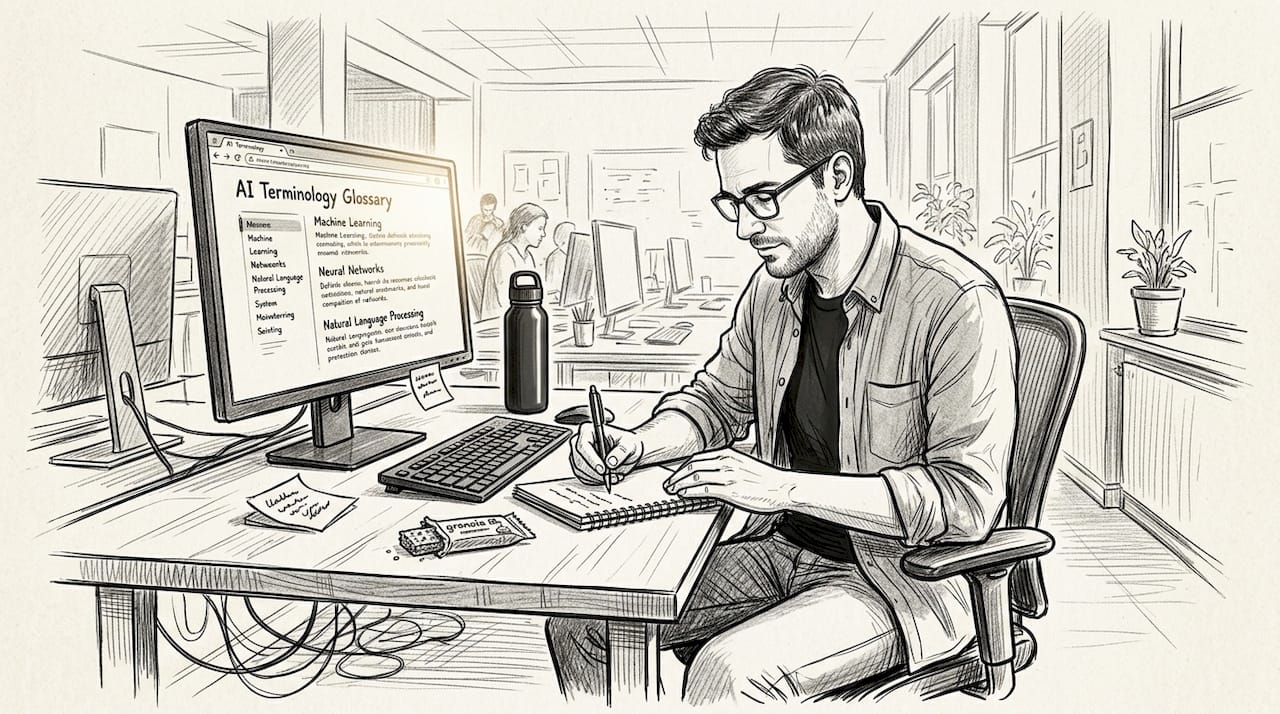
AI engineering terminology demystified
TL;DR:
- Rapid evolution of AI terminology impacts system design, collaboration, and technical comprehension in 2026.
- Key terms like RLHF, RAG, LoRA, and SFT define specific methods solving distinct AI development problems.
- Mastering precise vocabulary enhances communication, reduces errors, and advances engineers’ careers.
If you’ve sat through a technical meeting where someone casually dropped “SFT,” “LoRA,” and “RLHF” in the same breath and nodded along while quietly panicking, you’re not alone. Even engineers with years of production experience can feel lost when AI vocabulary shifts faster than model release cycles. The problem isn’t intelligence. It’s that the field genuinely moves fast, and terminology carries real technical weight. Getting these terms right isn’t just about sounding credible in interviews. It directly affects how you design systems, write specs, and collaborate with teams. This guide cuts through the noise and gives you a practical, clear breakdown of the terms that matter most in 2026.
Table of Contents
- Why is AI engineering terminology evolving so fast?
- The essential AI engineering terms every developer should know
- How to apply AI terminology in technical conversations and documentation
- Common pitfalls and misconceptions about AI terms in 2026
- A senior engineer’s take: Mastering terminology as an engine for career growth
- Grow your AI engineering expertise with advanced resources
- Frequently asked questions
Key Takeaways
| Point | Details |
|---|---|
| Terminology matters | A clear grasp of current AI vocabulary is critical for implementation and communication. |
| Practical application | Mastering terms lets you contribute more effectively to specs, reviews, and cross-team projects. |
| Avoid pitfalls | Understanding nuance prevents common misunderstandings that lead to project errors. |
| Career growth | Up-to-date language skills are a key factor for promotion and leadership roles in AI. |
Why is AI engineering terminology evolving so fast?
AI engineering isn’t a stable field with a fixed vocabulary. It’s a discipline being built in real time, and the language evolves alongside the methods. Three years ago, most engineers could get by knowing “training” and “inference.” Today, you’re expected to understand nuanced distinctions between pretraining, fine-tuning, and supervised fine-tuning, and explain why those differences matter for your architecture decisions.
This acceleration isn’t random. It’s driven by genuine technical progress. New training paradigms, alignment research, and efficiency techniques each introduce their own vocabulary. When a method like RLHF becomes central to how frontier models are developed, it stops being academic jargon and becomes a term your team will reference in sprint planning. The same applies to RAG, LoRA, and every other methodology that crosses from research into production.
“The engineers who advance fastest aren’t always the ones who code the most. They’re the ones who can translate technical complexity into clear language that drives decisions.”
Tracking AI job trends in 2026 makes this even clearer. Roles are increasingly specialized, and job descriptions now reference specific methodologies by name. If you don’t recognize those terms, you can’t evaluate fit, ask the right questions, or demonstrate depth in interviews. The digital transformation effects on engineering teams also mean more cross-functional collaboration, where precise vocabulary prevents costly misalignment between engineers and product stakeholders.
Here’s what shifts when you actively update your terminology:
- You read technical documentation faster and with better comprehension
- You contribute more confidently in architecture discussions
- You write clearer specs that reduce back-and-forth with product teams
- You identify when a proposed solution uses the wrong method for the problem
- You build credibility with senior engineers and hiring managers
Key AI engineering methodologies are driving rapid change, and staying current with that vocabulary isn’t optional if you want to operate at a senior level. It’s table stakes.
The essential AI engineering terms every developer should know
Let’s get specific. These six terms come up constantly in production AI work, technical documentation, and interviews. Understanding them precisely, not just vaguely, separates engineers who can lead implementations from those who follow instructions.
Key AI engineering methodologies include Pretraining, Fine-tuning, SFT, RLHF, RAG, and LoRA, and each solves a distinct problem in the AI development pipeline.
| Term | What it does | When you use it |
|---|---|---|
| Pretraining | Trains a model on massive unlabeled datasets to learn general language or vision patterns | Building or evaluating foundation models |
| Fine-tuning | Adapts a pretrained model to a specific domain using labeled data | Customizing models for vertical applications |
| SFT | Supervised fine-tuning using instruction-response pairs to shape model behavior | Instruction-following, chat, task-specific models |
| RLHF | Uses human feedback as a reward signal to align model outputs with human preferences | Safety, alignment, and quality improvement |
| RAG | Retrieves external documents at inference time and feeds them to the model as context | Grounding responses in current or private data |
| LoRA | Adds small trainable weight matrices to frozen model layers for efficient adaptation | Low-resource fine-tuning, edge deployment |
The most common confusion is treating fine-tuning and SFT as interchangeable. Fine-tuning is the broader category. SFT is a specific type of fine-tuning that uses structured instruction-response pairs to teach a model how to follow directions. You can fine-tune a model without doing SFT, but SFT is always a form of fine-tuning.
RAG is another term that gets stretched beyond its meaning. Some teams use it to describe any retrieval system, but RAG specifically refers to the combination of retrieval with a generative model at inference time. The retrieval isn’t just preprocessing. It’s integrated into the generation process.
For deeper context on how these terms connect to agent-based systems, the explained AI agent terms guide is worth reading alongside this one.
Pro Tip: When you encounter a new AI term in documentation or a paper, don’t just note the definition. Ask yourself: what problem does this solve, and what’s the alternative? That framing makes the term stick and helps you apply it correctly.
How to apply AI terminology in technical conversations and documentation
Knowing what a term means and using it correctly in context are two different skills. The second one is what actually moves your career forward. Precise language in technical settings prevents the kind of miscommunication that derails projects, delays launches, and creates friction between engineering and product teams.
Correct use of terminology improves collaboration and implementation, and the impact shows up in concrete ways: fewer revision cycles on specs, faster onboarding for new engineers, and cleaner code reviews where everyone is aligned on what a component is supposed to do.
Here’s a practical framework for embedding terminology into your daily engineering practice:
- Anchor terms to architecture decisions. When you write a design doc, name the specific method you’re using and why. Don’t write “we’ll adapt the model.” Write “we’ll apply LoRA to reduce compute cost while preserving base model performance.”
- Use terms in code review comments. When reviewing a RAG implementation, reference the specific component. “This retrieval step looks correct, but the context window may truncate before the generative model sees the most relevant chunk.”
- Define terms when onboarding junior engineers. Don’t assume shared vocabulary. A quick definition in a PR description or Slack message prevents confusion downstream.
- Align with product teams using plain language bridges. You can say “RLHF” to another engineer, but translate it for product: “We used human feedback to train the model to prefer helpful, accurate responses over confident-sounding but wrong ones.”
- Reference terminology in incident reports. When something breaks, naming the method that failed helps the team learn and prevents the same mistake in future implementations.
For a practical example of how this plays out in production, the guide on RAG in technical context shows how proper framing of retrieval-augmented generation changes both implementation quality and team alignment.
Pro Tip: Keep a personal glossary document in your notes app or Notion. Every time you encounter a term used in a new context, add a sentence about how it was applied. Over time, this becomes a reference that reflects real-world usage, not just textbook definitions.
If you’re focused on advancing your AI career, communication precision is one of the highest-leverage skills you can build.
Common pitfalls and misconceptions about AI terms in 2026
Even engineers who know these terms can misuse them. The errors tend to cluster around a few predictable patterns, and they have real consequences. Misuse of AI engineering terms leads to implementation errors or communication breakdown, and in production environments, that translates to wasted compute, delayed timelines, and frustrated stakeholders.
Here are the most common misconceptions to watch for:
- Treating RAG as a substitute for fine-tuning. They solve different problems. RAG grounds responses in external data at inference time. Fine-tuning changes the model’s weights. Using RAG when you need behavioral change won’t work.
- Confusing SFT with RLHF. SFT teaches a model to follow instructions using labeled examples. RLHF refines behavior using human preference signals as a reward. Both are used in alignment pipelines, but at different stages.
- Assuming LoRA is only for small models. LoRA is an efficiency technique that works across model sizes. It’s particularly valuable when you need to adapt large models without the compute cost of full fine-tuning.
- Using “pretraining” to mean any training. Pretraining specifically refers to the initial large-scale training on unlabeled data. Calling a fine-tuning run “pretraining” signals a gap in understanding that interviewers and senior engineers will notice.
| Often confused | Key distinction |
|---|---|
| Fine-tuning vs. SFT | SFT is a specific type of fine-tuning using instruction pairs |
| RAG vs. retrieval | RAG integrates retrieval into generative inference, not just preprocessing |
| RLHF vs. SFT | RLHF uses reward signals from human feedback; SFT uses labeled examples |
| LoRA vs. full fine-tuning | LoRA trains only small adapter matrices; full fine-tuning updates all weights |
The fix for most of these is straightforward: build the habit of checking your usage against a reliable reference before finalizing documentation or design decisions. Resources like AI agent misconceptions and must-learn AI concepts are useful checkpoints when you’re working in new territory.
The engineers who avoid these pitfalls aren’t necessarily smarter. They’re more deliberate about precision, and that habit compounds over time.
A senior engineer’s take: Mastering terminology as an engine for career growth
Most guides treat terminology as a prerequisite, something you check off before the real work starts. I’d argue it’s the opposite. The engineers who grow fastest treat vocabulary as an ongoing practice, not a one-time task.
Here’s what most articles miss: superficial familiarity with terms is common. Deep, precise understanding is rare. And rare skills get rewarded. When you can walk into a meeting, correctly identify that a proposed solution conflates RAG with fine-tuning, and explain why that matters for the architecture, you’ve just demonstrated senior-level judgment. That’s not about memorizing definitions. It’s about understanding the underlying logic well enough to catch errors in real time.
The engineers who move into leadership roles are often the ones who can translate between technical depth and business impact. They use precise language with engineers and clear, accessible language with stakeholders. That translation skill starts with terminology mastery. Building AI skills for senior roles means treating vocabulary as infrastructure, not decoration. Update it regularly, apply it deliberately, and it will carry you further than any single certification ever could.
Grow your AI engineering expertise with advanced resources
Understanding the language of AI engineering is a foundation, but the path to senior-level impact is built on implementation mastery too.
Want to learn exactly how to apply these AI engineering concepts in real production systems? Join the AI Engineering community where I share detailed tutorials, code examples, and work directly with engineers building RAG pipelines, fine-tuning workflows, and production AI systems.
Inside the community, you’ll find practical implementations of RLHF, LoRA, and RAG that go beyond terminology into working code, plus direct access to ask questions and get feedback on your architectures.
Frequently asked questions
What is RLHF, and why is it critical in 2026 AI engineering?
RLHF is a core 2026 AI engineering methodology for model alignment, using human preference signals as a reward to train models that behave safely and helpfully. It’s now a standard component in production pipelines for any model intended for user-facing applications.
How does RAG differ from standard retrieval in AI?
RAG integrates retrieval into AI for dynamic knowledge access by combining a retrieval step with a generative model at inference time, not just as preprocessing. Standard retrieval returns documents; RAG uses those documents as live context for generation.
Do I need to know LoRA to work on modern AI teams?
LoRA is a key 2026 technique for efficient adaptation, and understanding it is increasingly expected on teams that fine-tune models in resource-constrained environments. It’s especially relevant if you work with edge deployment or cost-sensitive infrastructure.
What’s the difference between fine-tuning and SFT?
SFT introduces instruction-tuned adjustments over basic fine-tuning by using structured instruction-response pairs to shape model behavior precisely. Fine-tuning is the broader category; SFT is a specific, targeted application of it.
Recommended
- AI Engineering Basics for Skills, Systems, and Your Career
- Master key AI engineering terms for career growth
- AI engineering vs ML engineering career guide for devs
- AI engineering skills checklist for career growth 2026