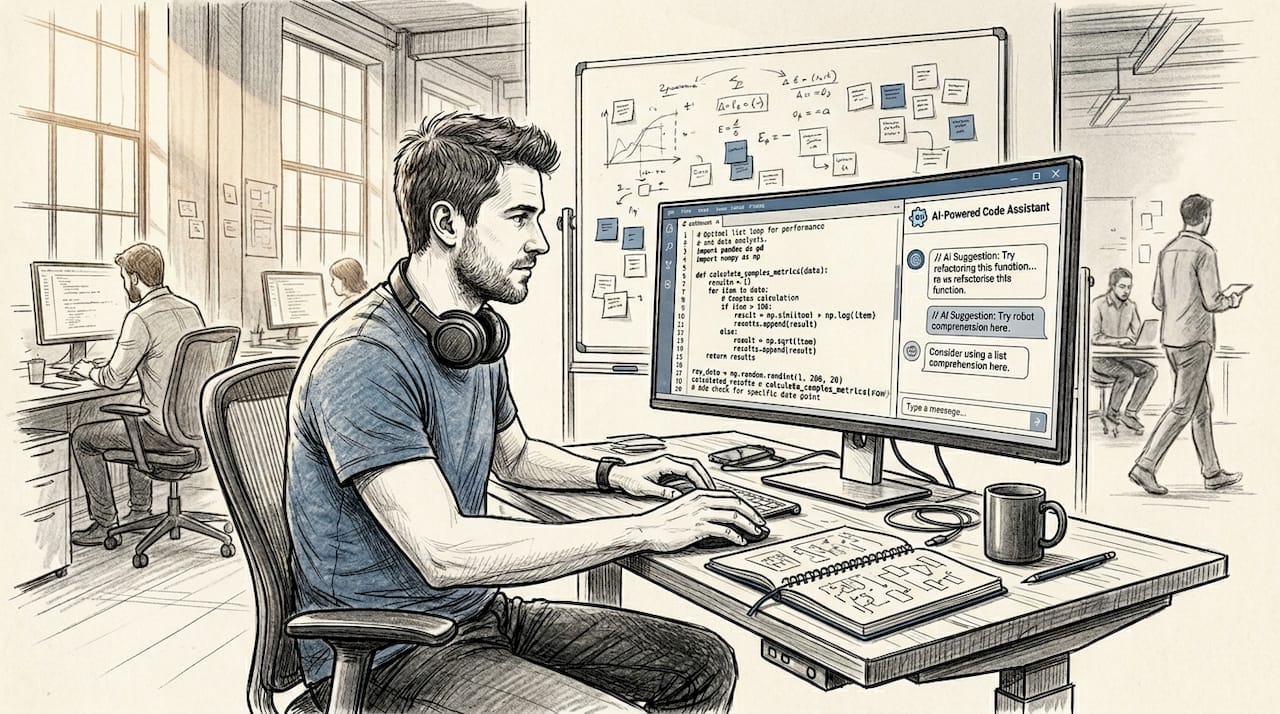
Defining an AI Sidekick Practical Guide for Engineers
Defining an AI Sidekick Practical Guide for Engineers
TL;DR:
- AI sidekicks are active collaborators requiring guidance, review, and structured prompts.
- Effective collaboration involves scoping tasks, reviewing all outputs, testing, and refactoring.
- Relying solely on AI outputs without oversight risks bugs, hallucinated logic, and technical debt buildup.
Most engineers approach AI coding tools with one of two flawed expectations: either they assume the AI will magically write production-ready software on its own, or they treat it as nothing more than a fancy autocomplete. Both miss the point entirely. As MIT research confirms, AI sidekicks should not be treated as autonomous code generators but rather as eager junior engineers who require guidance and review. This guide cuts through the noise to define what an AI sidekick actually is, how to collaborate with one effectively, and what practices separate engineers who unlock real productivity gains from those who accumulate hidden technical debt.
Table of Contents
- What is an AI sidekick? From myth to modern workflow reality
- How engineers interact with AI sidekicks: Patterns and processes
- Common pitfalls and how to avoid them
- Best practices for integrating AI sidekicks into your engineering workflow
- What most developers miss about AI sidekicks
- Ready to supercharge your engineering workflow with AI?
- Frequently asked questions
Key Takeaways
| Point | Details |
|---|---|
| AI sidekick fundamentals | AI sidekicks augment engineers, requiring guidance, incremental review, and collaboration. |
| Collaborative workflow | Effective AI integration depends on structured prompts, micro-tasking, and stepwise validation. |
| Avoid common pitfalls | Never blindly trust AI code. Review and test as rigorously as with new human teammates. |
| Implement best practices | Break work into smaller pieces and apply code review for all AI outputs before production use. |
| Culture matters | Developer culture and responsible AI adoption are key to long-term engineering success. |
What is an AI sidekick? From myth to modern workflow reality
The term “AI sidekick” gets thrown around loosely, and that ambiguity creates real problems in engineering teams. Let’s get precise.
An AI sidekick is a tool that works alongside you in an active, iterative loop. It generates code, suggests approaches, explains logic, and helps you move faster. But it does not make architectural decisions independently, it does not know your business context by default, and it absolutely cannot replace the judgment you bring as the engineer driving the project. Thinking of it as AI as infrastructure rather than a product in itself is the right mental model. It’s the plumbing that makes your work flow faster, not the architect who designs the building.
Here is how AI sidekicks differ from related tools:
| Tool type | Interaction style | Human oversight required | Output quality |
|---|---|---|---|
| AI sidekick (Cursor, Copilot) | Iterative, conversational | High. Review every diff | Moderate to high with guidance |
| Code generator (one-shot tools) | Single prompt, static output | Medium. Spot check | Variable, context-limited |
| Fully autonomous agent | Goal-driven, minimal prompting | Low in theory, high in practice | Unpredictable without guardrails |
| Traditional IDE autocomplete | Keystroke-level suggestions | Low | Narrow, deterministic |
The critical insight from MIT’s research is that the implementation nuance for an AI sidekick means treating the AI as an eager junior engineer: review diffs, refactor and test the output, and guide it with structured prompts and micro-steps. This is not a limitation to work around. It’s the correct mental model for getting reliable results.
What does this look like in practice? A few behaviors define effective AI sidekick collaboration:
- You give the AI a bounded, specific task rather than a vague directive.
- You review every meaningful change it produces before accepting it.
- You refactor and test its suggestions against your actual codebase.
- You treat its output as a first draft, not a final product.
Understanding AI-enhanced coding workflows in depth will help you see where exactly an AI sidekick fits within a broader engineering process. And if you’re building out a team, clarity on defining AI team roles matters just as much as knowing how the tools work individually.
“An AI sidekick is not your replacement. It’s the best junior engineer you’ve ever had. Fast, tireless, and genuinely dangerous if left unsupervised.”
Skip the review cycle even once, and you’re gambling with production code written by a system that cannot fully understand your codebase’s history, your team’s conventions, or your users’ edge cases.
How engineers interact with AI sidekicks: Patterns and processes
With a clear definition in place, the next step is understanding the practical, step-by-step interaction patterns between engineers and their AI sidekicks.
The most useful framework for thinking about AI sidekick interaction comes from tools like Cursor, which structures collaboration into three distinct modes. As guidance on Cursor pairing highlights, switching between “Ask,” “Plan,” and “Agent” modes while incrementally reviewing diffs during implementation reflects the review-and-iterate workflow that actually produces reliable results.
Here is how each mode maps to real situations:
| Mode | When to use it | Engineer’s role | Risk level |
|---|---|---|---|
| Ask | Exploring an unfamiliar API, debugging, brainstorming | Active interrogator | Low |
| Plan | Laying out implementation steps before writing code | Architect and approver | Low to medium |
| Agent | Executing a well-scoped task with minimal interruption | Reviewer and quality gate | Medium to high |
The mistake most engineers make is jumping straight into Agent mode for tasks they haven’t fully scoped. That’s like handing a new hire the full project on day one without a brief. You’ll get output, but you won’t trust it, and you shouldn’t.
Here is a repeatable workflow for effective AI sidekick collaboration on a feature or fix:
- Scope the task tightly. Define exactly what you want the AI to do, including the files it should touch and the behavior it should produce.
- Use Ask mode first. Get the AI’s understanding of the problem and surface any gaps in context before any code is written.
- Switch to Plan mode. Have the AI lay out its implementation steps so you can catch misalignments early.
- Approve the plan, then use Agent mode. Let it execute the scoped steps while you stay close.
- Review every diff. Not a skim. An actual read, line by line for anything touching critical paths.
- Run your tests. Always. No exceptions.
- Refactor where needed. The AI’s first pass is rarely how you’d write it yourself.
The shift toward agent-first AI adoption is happening across software organizations, but the teams seeing real gains are the ones pairing agent autonomy with rigorous human checkpoints, not removing them.
Pro Tip: Never deploy AI-generated code that hasn’t passed your full test suite. Treat every AI-authored diff the same way you’d treat a pull request from someone you’ve never worked with before. You would not merge that without reading it.
Digging into AI pair programming techniques will give you more tactical depth here, and if you want to optimize the full loop from prompt to production, optimizing AI pair programming covers the workflow refinements that make the biggest difference.
Common pitfalls and how to avoid them
Knowing how to interact with AI sidekicks is half the battle. The other half is recognizing what goes wrong, because even experienced engineers fall into predictable traps.
Pitfall 1: Blind trust in AI output. The most common mistake is accepting AI-generated code without meaningful review. This feels efficient in the moment and becomes very expensive later. Bugs from AI suggestions are often subtle, not syntactically wrong but semantically broken in ways that only surface under specific conditions.
Pitfall 2: Vague, unstructured prompts. If you ask an AI to “add authentication to this app,” you’ll get something that looks plausible but may not match your existing session management, your database schema, or your security requirements. Garbage in, garbage out applies just as much to AI sidekicks as it did to the functions you wrote as a junior developer.
Pitfall 3: Treating AI as a search engine replacement. Some engineers use their AI sidekick primarily for lookups rather than as a collaborative coding partner. You miss the real productivity leverage when you limit it to Q&A.
Pitfall 4: Skipping the test cycle. AI-generated code sometimes passes visual inspection and fails at runtime. MIT research specifically flags hallucinated logic and the risks of operating without confidence channels as core limitations of current AI coding models. Without a test suite catching these failures, you’re exposing yourself to production incidents that are genuinely hard to debug.
Pitfall 5: Inconsistent review standards. Engineers sometimes apply rigorous review to AI code in one sprint and skip it in the next when deadlines tighten. Inconsistency in oversight is how technical debt quietly multiplies.
Here’s what to do instead:
- Write tests before or alongside any AI-generated implementation, not after.
- Use structured prompt templates for recurring task types so context is consistent.
- Apply the same code review checklist to AI output as you would to a colleague’s PR.
- Establish a team norm: AI code is not trusted code until it’s reviewed code.
Pro Tip: Build a short “AI output checklist” for your team covering things like edge case handling, null safety, error propagation, and logging. Running AI-generated code through this checklist takes two minutes and catches a majority of issues before they reach review.
The practice of reviewing AI-generated code deserves its own deep dive, and the techniques for boosting productivity with AI only work reliably when you have the review layer in place. Intent-driven AI use is also worth understanding more broadly, since AI-driven intent innovation shows how organizations are rethinking workflows at a structural level.
Best practices for integrating AI sidekicks into your engineering workflow
Steering clear of common pitfalls sets you up for success. Here is a set of actionable best practices to guide your integration of AI sidekicks into real-world projects.
The core principle is simple: guide with structured prompts and micro-steps rather than letting the AI operate as an unreviewed code generator. That principle scales from solo side projects to enterprise codebases.
- Decompose every significant task into micro-steps. Instead of asking for a full feature, ask for one function, one route handler, one schema change at a time. Smaller context means more accurate output and easier review.
- Write your specification before prompting. Document what the code should do, what inputs it accepts, and what outputs it produces. Paste that spec into your prompt. This one habit dramatically improves first-draft quality.
- Use version control as your safety net. Commit before every major AI-driven change. This makes it trivial to roll back if the output takes your codebase somewhere you don’t want to go.
- Build a personal prompt library. Patterns that work once will work again. Store your best prompts for code review requests, refactoring tasks, test generation, and documentation so you’re not reinventing the wheel each session.
- Establish AI handoff checkpoints in your workflow. Define clear moments where you hand off to the AI and clear moments where you take back control. Ambiguity here is where things go wrong.
- Treat test coverage as a prerequisite, not a follow-up. Before delegating any non-trivial implementation to your AI sidekick, make sure the relevant test suite exists. The AI will write to pass tests if tests exist, and drift unpredictably if they don’t.
Here is a practical reference for task delegation decisions:
| Task type | AI sidekick role | Engineer oversight | Notes |
|---|---|---|---|
| Boilerplate and scaffolding | Primary author | Low review needed | Still check for project conventions |
| Business logic implementation | Co-author | High review required | Test coverage essential |
| Refactoring existing code | Suggest changes | Medium. Compare before/after | Risk of behavior drift |
| Debugging and root cause analysis | Research assistant | Medium | Validate proposed fix independently |
| Documentation generation | First draft author | Low to medium | Check for accuracy on edge cases |
| Security-sensitive code | Reference only | Full manual implementation | Do not delegate without expert review |
These practices apply whether you’re working solo or within a larger team. Exploring enterprise AI workflows will show you how these principles scale, and AI project management tools can help you integrate AI sidekick usage into your project planning process. If you want a full picture of how these workflows connect end-to-end, mastering AI project workflows brings the pieces together into a coherent system.
What most developers miss about AI sidekicks
Here is a perspective that rarely comes up in tool comparisons and benchmark discussions: the real competitive advantage of an AI sidekick has nothing to do with code generation speed. It’s about amplifying your decision-making quality as an engineer.
When you use an AI sidekick well, you’re not saving time writing boilerplate. You’re freeing up cognitive capacity to think more carefully about architecture, edge cases, user behavior, and long-term maintainability. That’s the shift most developers never make. They optimize for keystrokes saved and miss the deeper leverage entirely.
The second thing teams miss is the cultural dimension. Introducing an AI sidekick into a team changes how collaboration works. Who reviews AI-generated code? Who owns a bug that came from an accepted AI suggestion? How transparent should engineers be about which parts of a PR were AI-assisted? These questions don’t have obvious answers, and teams that ignore them create friction and inconsistency without realizing why.
There’s also a subtle risk that doesn’t get talked about enough: engineer disengagement. When organizations push speed-only metrics and treat AI adoption as a cost-cutting exercise, engineers start to feel like prompt operators rather than craftspeople. That matters beyond the philosophical level. Disengaged engineers stop scrutinizing AI output carefully, and that’s precisely when technical debt accelerates fastest.
The engineers who will lead the next phase of AI-augmented teams are not the ones who let the AI do the most work. They’re the ones who build rigorous review habits, communicate clearly about AI handoffs, and use AI output as a starting point for better thinking, not a substitute for it. Understanding practical AI implementation strategies can help you build this kind of disciplined, high-leverage practice rather than chasing every new tool that promises to automate more.
AI sidekicks reward the engineer who slows down to structure their prompts, review their diffs, and hold the AI accountable to the same standards they’d hold a teammate. The shortcut mentality produces the opposite of what it promises.
Ready to supercharge your engineering workflow with AI?
Want to learn exactly how to integrate AI sidekicks into production-grade engineering workflows? Join the AI Engineering community where I share detailed tutorials, code examples, and work directly with engineers building AI-augmented development systems.
Inside the community, you’ll find practical strategies for structuring AI collaboration that actually work for shipping production code, plus direct access to ask questions and get feedback on your implementations.
Frequently asked questions
What is the main difference between an AI sidekick and a code generator?
An AI sidekick is an active collaborator that requires guidance, review, and structured prompts, while a basic code generator outputs code with minimal interaction or oversight. As MIT research notes, the sidekick model depends on a review-and-iterate workflow that a one-shot generator simply doesn’t support.
Should engineers trust AI sidekicks to write production-ready code?
No. Engineers should always review, test, and refactor AI-generated code before deploying to production. MIT’s study reinforces that AI output must be treated with the same scrutiny as code from any junior engineer joining your team.
How can I get the most reliable results from an AI sidekick?
Break tasks into smaller steps, give clear and structured prompts, and always test every output before accepting it. Structured prompts and micro-steps consistently produce higher-quality, more predictable results than open-ended requests.
What should I do if an AI sidekick provides buggy or hallucinated code?
Refactor, test, and apply your standard code review practices to catch and correct errors before anything reaches production. MIT’s research specifically highlights hallucinated logic risks as a known limitation that rigorous review is designed to catch.
Recommended
- Agentic AI and Autonomous Systems Engineering Guide
- AI Agent Development Practical Guide for Engineers
- AI Coding Assistants Implementation Guide for Engineers
- Implementation-Focused Guidance in AI Mentorship Programs
- Why AI is Your Infrastructure, Not Your Product