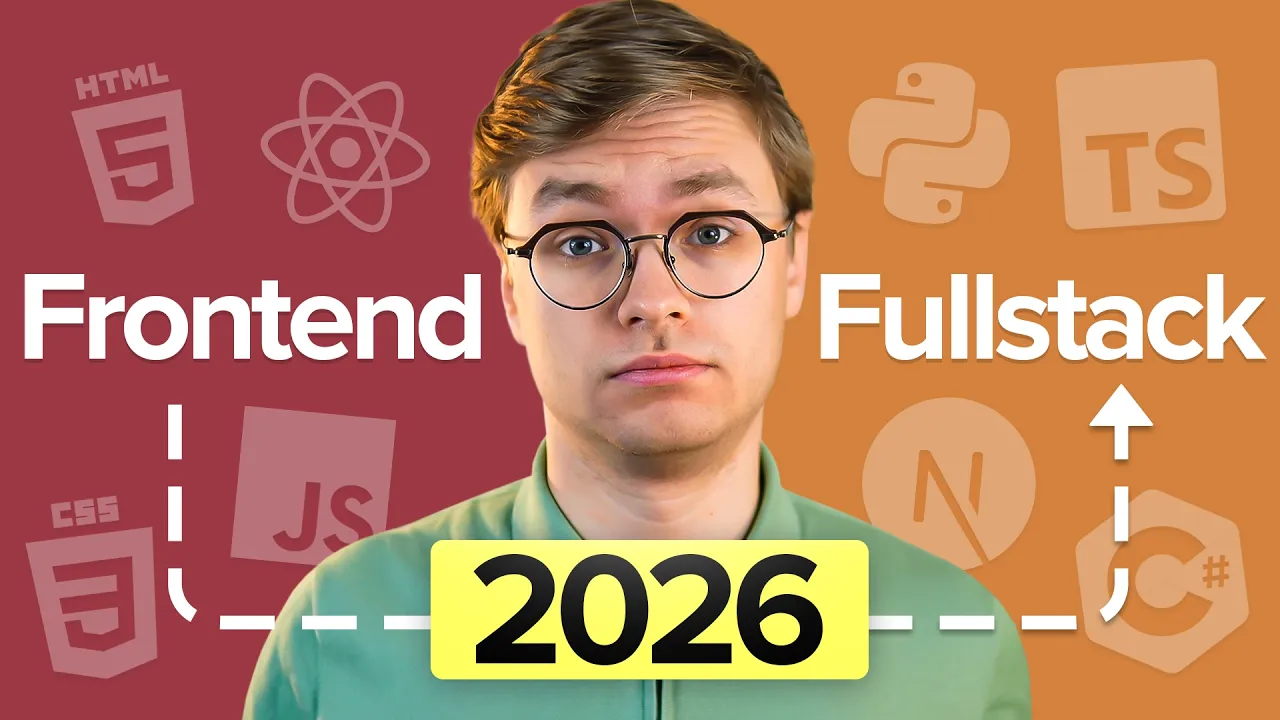
Front-End to Full-Stack Developer Transition Guide
Full-stack developer roles have increased 9% while front-end-only positions are declining. Stack Overflow data already showed that for every developer who identifies as purely front end, six identify as full stack. If you are a front-end developer wondering how to future-proof your career, the transition path is shorter than you think.
The reason is TypeScript. The same language you already use for React components can now power your entire application, from the UI layer to API routes to database queries. You do not need to learn Python, Go, or Java to become a full-stack developer.
Why the Market Is Shifting
Companies want engineers who understand how the front end connects to the back end. The era of siloed roles is fading. When a team needs someone to build a feature, they increasingly want one person who can handle the React component, the API endpoint, and the database query rather than three specialists coordinating handoffs.
This is not speculation. The job posting data confirms it. Full-stack roles are growing while front-end-only roles shrink. Companies like Netflix, Spotify, and Uber run subsystems on frameworks that unify front-end and back-end development in a single TypeScript codebase.
For front-end developers, this shift is actually good news. You are closer to full-stack than you realize. The hardest part of becoming a developer, thinking in components, managing state, understanding async operations, you already have that foundation.
The TypeScript Bridge
Going full-stack used to mean learning a completely different language and ecosystem for the back end. Python with Flask or Django. Java with Spring. Ruby with Rails. Each required months of investment in a new syntax, new tooling, new mental models.
TypeScript changed that equation. With frameworks like Next.js, you can write API routes in the same language you already know. Your React components and your server-side logic share the same type system. A type you define for a user object works identically whether you are rendering it in a component or validating it in an API handler.
This is not about picking the “right” framework. It is about recognizing that TypeScript lets you extend your existing skills rather than starting from scratch. You add server-side patterns on top of what you already know.
For a deeper look at how these full-stack skills connect to the AI engineering career path, the overlap is significant. AI product development requires engineers who can build the full stack from user interface to model integration.
The Three to Six Month Roadmap
Most front-end developers can become competent full-stack engineers in three to six months. Not years. Here is the progression that works.
Month one: Server-side fundamentals. Learn how API routes work in a TypeScript framework. Understand request handling, middleware, and basic authentication patterns. You already know async/await from front-end work, so the concepts transfer directly.
Month two: Database integration. Pick up a type-safe ORM that gives you database queries with full TypeScript support. Your queries become type-checked just like your components. Missing a required field? The compiler tells you before you run anything.
Month three: Connect everything. Build a complete application where your React front end talks to your own API routes, which talk to your own database. This is the project that separates front-end developers from full-stack developers in interviews.
Months four through six: Production patterns. Add error handling, caching, environment configuration, and deployment. These are the details that signal production experience to hiring managers.
The key insight is that each month builds on skills you already have. You are not learning a foreign ecosystem. You are expanding your TypeScript knowledge into new territory.
What This Looks Like in Practice
A voice transcription application with a TypeScript React front end and AI integration demonstrates exactly what companies look for. It proves you understand how front-end components consume backend APIs. It shows you can integrate third-party services. It gives you something concrete to discuss in interviews without needing a whiteboard.
The ability to explain how data flows from a user interaction through your API to a database and back is what separates full-stack AI engineers from developers who only know one layer.
Front-End Skills Still Matter
Going full-stack does not mean abandoning front-end expertise. TypeScript makes you better at front-end development too. State management in large React applications becomes easier with type support. Refactoring is safe because the compiler shows you every place that needs updating. Other developers stop guessing about your code because the types serve as documentation.
If you choose to stay front-end focused, TypeScript still increases your value. But if you want to expand your opportunities, the full-stack path through TypeScript is the lowest friction route available.
Your Next Move
If you are still writing plain JavaScript, learn TypeScript properly first. Understanding generics, utility types, and type inference will change how you approach code structure and prepare you for the full-stack transition.
If you already know TypeScript, start building something with API routes and a database. That project becomes your proof of full-stack capability.
To see a complete TypeScript full-stack project in action, watch the full video on YouTube. I walk through a working application that demonstrates the front-end to back-end connection with AI integration. To connect with other developers making this transition, join the AI Engineering community where we share resources, project feedback, and career guidance.