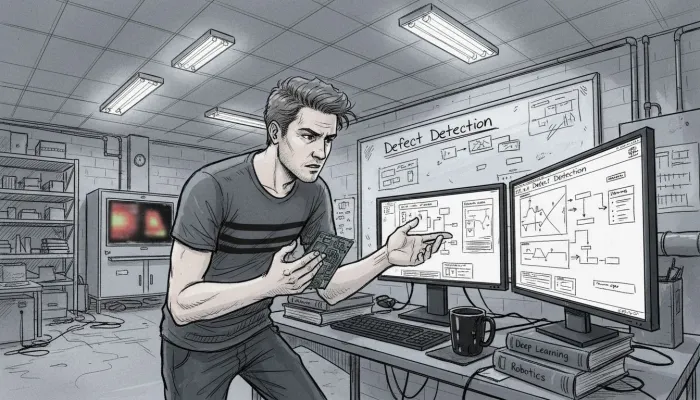
Fundamentals of Computer Vision Real-World Impact for AI Engineers
Fundamentals of Computer Vision: Real-World Impact for AI Engineers
Many aspiring AI engineers grapple with misconceptions about how computer vision actually works. While it might seem intuitive to compare machine vision to human perception, this leads to frustration and wasted effort. Understanding that computer vision processes digital pixel arrays and extracts mathematical patterns is crucial for building successful models. This article clarifies common misunderstandings, breaks down core analytical methods, and offers practical advice for achieving reliable results in real-world projects.
Table of Contents
- Computer Vision Basics and Common Misconceptions
- Core Methods in Image and Video Analysis
- Key Applications Transforming Industries
- Essential Skills for Aspiring AI Engineers
- Challenges, Limitations, and Common Pitfalls
Computer Vision Basics and Common Misconceptions
Computer vision often gets shrouded in mystery. Most people assume it works like human vision, but that’s nowhere near accurate. Understanding the real fundamentals saves you months of frustration when building AI systems.
What computer vision actually does is extract meaningful information from digital images and videos. It doesn’t “see” the way you do. Instead, it processes pixel values, detects patterns, and builds mathematical representations of visual data.
Here’s what happens under the hood:
- Image acquisition captures raw pixel data from cameras or sensors
- Preprocessing cleans and standardizes the image (resizing, normalization, filtering)
- Feature extraction identifies edges, textures, and distinctive patterns
- Analysis and interpretation applies algorithms to recognize objects, classify content, or make predictions
Most misconceptions stem from comparing machine vision to human perception. Understanding image features and sensor properties clarifies why computers struggle with things humans find trivial, like recognizing the same object from different angles or under varying lighting.
Here’s a summary comparing human visual perception and computer vision systems:
| Aspect | Human Vision | Computer Vision |
|---|---|---|
| Input Processing | Continuous, analog light signals | Digital pixel arrays |
| Context Awareness | Deep contextual understanding | Pattern recognition only |
| Generalization | Easily adapts to new scenes | Requires retraining for changes |
| Sensitivity to Conditions | Robust to lighting and viewpoint shifts | Easily disrupted by environmental changes |
| Learning Style | Lifelong and incremental | Depends on labeled/unlabeled data |
Core Misconceptions That Trip Up Engineers
Misconception 1: Computer vision needs to understand context like humans do. Wrong. It excels at pattern matching within constrained scenarios. A model trained on cats recognizes specific visual signatures in cat photos. It doesn’t “understand” what a cat is philosophically.
Misconception 2: More pixels always mean better results. False. Higher resolution increases computational cost without guaranteed accuracy improvements. What matters is having relevant features at the right scale for your specific problem.
Misconception 3: A computer vision model works the same across different environments. This one costs engineers real money. A model trained on daytime outdoor footage fails spectacularly at night. Lighting, camera quality, and environmental conditions dramatically affect performance.
Misconception 4: You need massive datasets for any vision task. Not necessarily. Transfer learning lets you leverage pre-trained models and achieve solid results with smaller, focused datasets. This is how most production systems actually work.
Effective computer vision projects focus on the specific problem domain, not on chasing perfect accuracy on generic benchmarks. Real-world performance matters infinitely more than theoretical metrics.
The distinction between supervised learning (labeled data) and unsupervised learning (unlabeled data) shapes how you approach vision problems. Most practical applications combine both. You might use unsupervised clustering to find patterns, then train supervised classifiers on the results.
When you start building vision systems, you’ll encounter common challenges and practical solutions that separate novice projects from production deployments.
Pro tip: Start by understanding what your vision model actually needs to solve. Define the specific visual patterns or objects that matter for your use case, then gather focused training data around those patterns. This targeted approach delivers results faster than trying to build a “general-purpose” vision system.
Core Methods in Image and Video Analysis
Image and video analysis sits at the heart of practical computer vision work. You need to understand the core methods that actually power real applications, not just theoretical concepts. These techniques transform raw pixels into actionable intelligence.
Image filtering forms the foundation of analysis. It cleans data, enhances features, and removes noise before deeper processing. Common filters include Gaussian blur for smoothing and edge detection filters like Sobel operators that highlight boundaries between objects.
Here are the key methods you’ll use repeatedly:
- Convolution applies mathematical filters across images to detect patterns and extract features
- Edge detection identifies object boundaries through gradient analysis
- Feature extraction isolates distinctive visual markers that algorithms can track and match
- Multiscale representations analyze images at different zoom levels to capture features at various scales
- Motion estimation tracks how pixels change between video frames
Understanding image filtering and transformation techniques provides the mathematical and algorithmic foundations needed for effective visual analysis. These methods enable you to detect objects, measure movement, and recognize patterns across billions of pixels.
Practical Methods for Real-World Problems
Convolutional Neural Networks (CNNs) dominate modern image analysis. They automatically learn which features matter for your specific problem. A CNN trained on medical imaging learns to spot tumors. The same architecture trained on manufacturing data detects product defects. You don’t hardcode the features. The network discovers them.
Optical flow tracks motion in video sequences. It answers the question: where did each pixel move between frames? This powers video surveillance, autonomous vehicles, and gesture recognition systems.
Background subtraction separates moving objects from static scenes. Security cameras use this constantly. It’s computationally efficient and works surprisingly well in controlled environments like factories or storefronts.
Feature matching finds the same object across different images. How to build AI applications that process images, video and audio requires mastering these core techniques. SIFT, ORB, and AKAZE are algorithms that identify distinctive points and match them reliably even when images are rotated, scaled, or partially obscured.
The most effective computer vision pipelines combine multiple methods. You might use CNN for classification, optical flow for motion, and feature matching for tracking. Not because each alone is perfect, but because together they solve real problems.
Video analysis adds temporal complexity. You’re not just looking at one frame. You’re understanding sequences. Temporal filtering smooths predictions across frames so results don’t jitter. Action recognition classifies what’s happening: is someone walking, running, or falling?
Pro tip: Start with simpler methods before reaching for deep learning. Edge detection and background subtraction often solve problems faster and require less computational power. Add neural networks only when simpler approaches consistently fail to meet your accuracy targets.
Key Applications Transforming Industries
Computer vision isn’t theoretical anymore. It’s actively transforming how industries operate, cut costs, and create competitive advantages. Understanding these real-world applications shows you where your skills will create the most value.
Autonomous vehicles depend entirely on computer vision. Cameras detect lanes, pedestrians, obstacles, and traffic signals in real time. A self-driving car processes multiple video streams simultaneously, making split-second decisions based on visual analysis. This technology is reshaping transportation and logistics.
Here are the industries being fundamentally transformed:
- Healthcare uses vision for tumor detection, surgical guidance, and pathology analysis
- Manufacturing applies vision for quality control, defect detection, and predictive maintenance
- Retail deploys vision for inventory tracking, customer behavior analysis, and checkout automation
- Security relies on vision for surveillance, threat detection, and access control
- Agriculture uses vision for crop monitoring, disease detection, and yield prediction
Medical imaging analysis saves lives daily. Radiologists now work alongside AI systems that detect cancers, fractures, and abnormalities faster and sometimes more accurately than humans alone. Computer vision algorithms scan thousands of images to identify patterns humans might miss.
Manufacturing quality control represents massive ROI. Vision systems inspect products at factory speeds, detecting microfractures, color inconsistencies, or assembly errors in milliseconds. Digital twins using computer vision and AI enable predictive maintenance, reducing unexpected downtime and equipment failures.
Retail is being reimagined through vision. Smart shelves with cameras track inventory automatically. Checkout-free stores count items as customers grab them. Loss prevention systems identify suspicious behavior before theft occurs.
This table highlights business impact across industries transformed by computer vision:
| Industry | Core Application | Key Business Impact |
|---|---|---|
| Healthcare | Tumor detection, surgical support | Faster diagnosis, higher accuracy |
| Manufacturing | Quality control, defect detection | Fewer defects, lower costs |
| Retail | Inventory, checkout automation | Reduced shrinkage, better tracking |
| Security | Real-time surveillance, access control | Enhanced safety, proactive threat response |
| Agriculture | Crop monitoring, yield prediction | Increased output, early issue detection |
The companies capturing the most value from computer vision aren’t building generic solutions. They’re solving specific, measurable problems in their industry: reducing defect rates by 23%, cutting inspection time by 67%, or preventing 8 out of 10 equipment failures.
Security and surveillance remains the largest application by volume. Modern systems don’t just record video. They actively understand what’s happening. Crowd density monitoring, perimeter intrusion detection, and behavioral analysis happen in real time across thousands of camera feeds simultaneously.
Internal AI tools engineers create generate company-wide value by solving problems specific to how organizations actually work. You’re not building for a generic market. You’re building for production environments with real constraints, real data, and real business impact.
Pro tip: Focus on applications where vision solves a problem that currently costs your organization money or time. Defect detection saving manufacturing lines thousands per hour, medical imaging speeding diagnosis by days, or retail reducing shrinkage by thousands weekly. These are the projects that justify implementation and advance your career.
Essential Skills for Aspiring AI Engineers
Computer vision skills alone won’t make you a strong AI engineer. You need a broader foundation that includes machine learning fundamentals, solid coding ability, and understanding of ethical AI principles. This combination makes you genuinely valuable in production environments.
Programming proficiency remains non-negotiable. You must write clean, efficient code that scales. Python dominates AI work, but you also need solid grasp of software engineering practices: version control, testing, debugging, and documentation. Writing production code differs dramatically from scripts that work once.
Here are the core competencies every aspiring AI engineer needs:
- Machine learning fundamentals including supervised and unsupervised learning, model evaluation, and hyperparameter tuning
- Deep learning architectures such as CNNs, RNNs, and transformers with hands-on implementation experience
- Data handling skills for preprocessing, augmentation, and working with imbalanced datasets
- Model debugging and evaluation to identify why systems fail and how to improve them
- Ethical AI practices including fairness, transparency, and responsible deployment
Model evaluation and debugging separates competent engineers from mediocre ones. You must understand precision, recall, F1-scores, confusion matrices, and when each metric matters. More importantly, you need skills to diagnose why models fail and systematically improve performance.
Building and fine-tuning AI models requires practical implementation skills that go far beyond theory. You’re learning rigorous approaches to model development, evaluating performance objectively, and understanding ethical implications of your deployments.
Ethical AI development isn’t optional anymore. Responsible AI design emphasizes human oversight, transparency, and worker safety. You need to understand bias in datasets, fairness in model predictions, and the real-world consequences of your systems. This knowledge differentiates senior engineers from junior ones.
Implementation skills matter more than theoretical knowledge alone because production systems require deployment experience, performance optimization, and continuous monitoring.
The engineers getting hired fastest aren’t those with perfect theoretical knowledge. They’re people who can take a business problem, build a working solution, evaluate its performance honestly, and deploy it responsibly.
Computer vision specifically demands you master feature extraction, transfer learning, and common architectures like ResNet, YOLO, and Vision Transformers. But you also need to understand when to use each approach and why simpler methods sometimes outperform complex ones.
Pro tip: Build a portfolio with 3-5 complete projects where you solved real problems using computer vision. Document your process, including failures and what you learned. Employers care far more about demonstrated ability than certifications or theoretical knowledge.
Challenges, Limitations, and Common Pitfalls
Computer vision looks impressive in demos. Real production systems fail constantly in ways that surprise even experienced engineers. Understanding these challenges prevents you from wasting months on approaches that were doomed from the start.
Data quality determines everything. A model trained on poor-quality images with biased labels will never perform well, regardless of architecture sophistication. If your training data doesn’t represent the real world where the model will operate, it will fail spectacularly in production.
Here are the major challenges you’ll face:
- Lighting variations cause dramatic performance drops when conditions differ from training data
- Occlusions and partial visibility make object detection extremely difficult
- Domain adaptation problems occur when training and test environments differ
- Overfitting happens when models memorize training data instead of learning generalizable patterns
- Computational constraints limit what architectures you can deploy in real-time systems
The 3D-from-2D problem is fundamental. Computer vision must infer three-dimensional reality from two-dimensional images. This is mathematically ill-posed. Infinite 3D scenarios can produce identical 2D images. You’re always working with incomplete information.
Understanding variability in image formation, sensor noise, and lighting conditions is critical because these factors compound in real deployments. A model that works perfectly indoors fails outdoors. A system trained on daytime footage becomes useless at night.
Overfitting destroys models silently. Your validation metrics look great. Then the model encounters real data and performance collapses. This happens because the model learned specific quirks of your training set rather than generalizable features. You catch this through rigorous testing, not assumptions.
Feature detection and segmentation accuracy remain fundamentally difficult. Common pitfalls include poor dataset quality and misinterpretations of algorithm outputs that engineers don’t catch until deployment. You need skepticism about your own results.
The most expensive computer vision failures aren’t technical. They’re projects that engineers built perfectly but nobody actually needed or could deploy profitably.
Domain shift costs money. A model trained on synthetic data performs worse on real images. Models trained on one camera fail with different cameras. Seasonal changes break systems trained only on summer footage. You must account for this variability during development.
Computational cost is a hard constraint. Processing every frame from 50 security cameras in real time requires careful architecture choices. You can’t always use the largest, most accurate model if it takes 5 seconds per frame.
Understanding why AI projects fail reveals patterns in computer vision specifically. Most failures aren’t about vision algorithms. They’re about unrealistic expectations, inadequate testing, or mismatch between what you built and what the business actually needed.
Pro tip: Test your model on data collected under different conditions than your training set before deployment. If performance drops more than 15 percent, you haven’t solved the real problem yet. This harsh reality check saves months of wasted time later.
Want to learn exactly how to build production computer vision systems that actually work? Join the AI Engineering community where I share detailed tutorials, code examples, and work directly with engineers building real AI applications.
Inside the community, you’ll find practical computer vision strategies and deployment patterns, plus direct access to ask questions and get feedback on your implementations.
Frequently Asked Questions
What is the main purpose of computer vision?
Computer vision’s main purpose is to extract meaningful information from digital images and videos by processing pixel values and detecting patterns.
How do convolutional neural networks (CNNs) benefit image analysis?
CNNs automatically learn which features are important for specific problems, allowing them to effectively analyze images for tasks like tumor detection or defect identification without needing hardcoded features.
What are some common challenges faced in computer vision projects?
Common challenges include data quality issues, lighting variations, occlusions, and the need for domain adaptation, which all can affect model performance in real-world applications.
Why is ethical AI development important in computer vision?
Ethical AI development is crucial to ensure fairness, transparency, and responsible deployment, which helps mitigate biases in models and fosters trust in AI systems.
Recommended
- Computer Vision Challenges Practical Solutions for AI Engineers
- 7 Essential Applications of Computer Vision for AI Engineers
- 7 Essential Applications of Computer Vision for AI Engineers
- AI Image Generation in Development Workflows
- AI in Business and AI Literacy.
- Understanding the Role of Artificial Intelligence in Logistics - ORNER
