Smallest Local LLM That Still Feels Like ChatGPT
Every week someone messages me asking the same question. They want the smallest local LLM that still feels like ChatGPT. They have a laptop with maybe 8GB of VRAM, they do not want to drop two thousand dollars on a 5090, and they want a model that actually answers like the assistant they have been using in a browser tab. After hundreds of hours testing models on my RTX 5090 and on weaker hardware, I have an honest answer for you, and it is not the one most YouTube channels will give you.
The sweet spot for local chat sits between 3 billion and 7 billion parameters on consumer hardware. Below that, models collapse on anything beyond surface reasoning. Above it, you cannot run them on a normal machine. So I am going to walk you through the real contenders in that window. Phi-3.5 Mini at 3.8B, Llama 3.2 3B, Qwen 2.5 7B, and Gemma 2 9B. I will tell you where each feels like ChatGPT-3.5, where they fall apart, and what the honest hardware floor looks like.
Why is the 3B to 7B range the real sweet spot?
When people first try local AI, they go too small or too big. They download a 1B model, see incoherent responses, and conclude local AI is a joke. Or they try to load a 70B model on a gaming GPU, watch it crawl at one token per second, and decide local AI is impossibly slow.
The 3B to 7B range is where things change. Modern training has squeezed enough capability into this footprint to hold a conversation, follow multi-step instructions, and produce useful prose. It is also the band where you can run a model on hardware most people already own. A 7B model at 4-bit quantization fits in roughly 5GB of VRAM, which runs on a modest laptop GPU, Apple Silicon with unified memory, or even integrated graphics with patience.
We are not trying to recreate GPT-5 with reasoning or Claude Opus doing agentic coding. We are trying to get back to that feeling from late 2022 where you could ask a question and get a thoughtful paragraph back. That target is achievable now. If you want a deeper breakdown of when to go local versus cloud, my local versus cloud LLM decision guide covers the full tradeoffs.
How does Phi-3.5 Mini hold up at 3.8 billion parameters?
Phi-3.5 Mini is the smallest model I would recommend for a ChatGPT-like experience. Microsoft trained it on heavily curated synthetic data, and it punches above its weight class. On benchmarks it sometimes matches models twice its size, and in casual conversation it feels surprisingly capable.
Where Phi-3.5 shines is well-scoped questions. Ask it to explain a concept, summarize a paragraph, draft a quick email, or answer a factual question, and it does a respectable job. The 128k context window is genuinely useful for a model this small, so you can paste in a document and ask questions about it.
Where it falls apart is open-ended creative work and anything requiring world knowledge outside its curated training set. Ask it for a long story and it loses the thread. Ask about a niche topic and it confidently makes things up. The synthetic data approach gives strong reasoning on common patterns but leaves blind spots that GPT-3.5 did not have, because GPT-3.5 was trained on a much wider slice of the actual internet.
The hardware floor is low. Phi-3.5 Mini at 4-bit fits in under 3GB of VRAM, and almost any dedicated GPU from the last five years handles it. If you want to figure out what your machine can run, my VRAM requirements local AI coding guide breaks down the math by model size and quantization level.
Is Llama 3.2 3B actually usable for daily chat?
Llama 3.2 3B is the model I recommend most often to beginners. Meta released it specifically for on-device use cases, and it shows. The model is fast, reasonably accurate, and fine-tuned hard for instruction following.
In daily chat, Llama 3.2 3B feels like a competent intern. It answers your questions, follows formatting requests, and produces prose that reads like a human wrote it. This is the model I point a friend at when they want to dip a toe into local AI without spending money or configuration time.
The weaknesses are predictable. Math beyond basic arithmetic gets shaky. Multi-step reasoning collapses around the third or fourth hop. Code generation works for trivial snippets but breaks on anything needing awareness of multiple files. The 128k context window is theoretical. In practice you see noticeable quality degradation after a few thousand tokens.
For the smallest local LLM that feels like ChatGPT, Llama 3.2 3B is the floor. Below it you are not in ChatGPT territory anymore. At 3B parameters with 4-bit quantization, you need about 2GB of VRAM, so this runs on a five-year-old gaming laptop without thinking twice.
Get the local AI starter projects
Before we get into the heavier 7B and 9B contenders, I want to point you at something practical. I have put together a collection of my own open-source projects covering most of the local AI use cases in this post, including chat interfaces, RAG pipelines, and starter configurations. You can browse the local AI starter projects here and skip the setup work I had to do the first time.
Why does Qwen 2.5 7B feel like the real ChatGPT replacement?
If I had to pick one model as the actual answer to this post, it would be Qwen 2.5 7B. In my testing, this is the model that comes closest to recreating the ChatGPT-3.5 experience locally on consumer hardware. Alibaba has been quietly producing some of the strongest open weights in the industry.
Three things make Qwen 2.5 7B feel like ChatGPT. First, it has broad world knowledge across history, science, code, languages, and pop culture. Second, its instruction following is strong. Ask it to respond in a specific format or persona, and it actually does. Third, its reasoning chains hold together longer than the smaller models. You can have three or four turns of context-dependent questions and it keeps up.
Where Qwen 2.5 7B falls apart is truly novel reasoning. Frontier cloud models have an extra layer that lets them solve problems they have never seen. Ask Qwen for first-principles reasoning about an unfamiliar domain and it falls back on pattern matching, producing plausible-sounding but wrong answers. ChatGPT-3.5 had the same problem, so if your bar is GPT-3.5, Qwen 2.5 7B clears it.
Hardware floor at 4-bit is around 5GB of VRAM, which fits on most modern laptop GPUs, any 8GB desktop card, and a Mac with 16GB of unified memory. For the math behind why this works, model quantization is the key to faster local AI performance covers exactly why a 7B model drops from 14GB to 5GB without much quality loss.
Where does Gemma 2 9B fit in?
Gemma 2 9B is the upper bound of what I still call the small local LLM range. At 9 billion parameters it is bigger than the others, but still in consumer hardware territory.
Google designed Gemma 2 as the open counterpart to its Gemini family, and the polish shows. The conversational tone feels more natural than Qwen at times. Refusals are more graceful. Formatting is more consistent. For a model that feels closer to a polished commercial product out of the box, Gemma 2 9B is the one.
The tradeoff is hardware. At 4-bit you need around 6 to 7GB of VRAM, and inference is noticeably slower than the 7B contenders on the same hardware. On a laptop with 8GB of VRAM you will feel the difference. On a 12GB or 16GB desktop card you will not.
Gemma 2 9B genuinely beats the smaller models in nuanced writing tasks. For content drafts, summaries with subtle judgment, or anything where prose quality matters, Gemma 2 9B gets closest to ChatGPT. For raw question answering and code, Qwen 2.5 7B holds its own and runs faster.
What is the actual hardware floor for a ChatGPT-like local experience?
Most posts dance around the numbers, so here they are. To get a 7B model running at usable speeds with 4-bit quantization, you need roughly 5GB of VRAM and at least 200 GB per second of memory bandwidth. That means any dedicated GPU from the RTX 3060 generation or newer, any Apple Silicon Mac with 16GB or more of unified memory, or a recent AMD card with ROCm support.
Below that floor you have two options. Step down to the 3B class with Llama 3.2 3B or Phi-3.5 Mini and accept the quality drop. Or run the 7B model on CPU only and accept five to ten tokens per second instead of thirty. CPU-only is fine for casual use but does not feel like ChatGPT anymore.
Setup has gotten dramatically easier. LM Studio handles downloads, quantization, and the chat interface. Ollama gives you a clean command-line workflow. Open WebUI mimics the ChatGPT layout almost exactly. For the full picture from hardware selection to model choice, my local LLM setup cost-effective guide covers it.
When does a small local LLM stop feeling like ChatGPT?
There are specific situations where every model in this post will let you down compared to ChatGPT.
Long conversations are the first. Local models in this size range are constrained on context window in practice, even when the marketing claims 128k tokens. After a few thousand tokens of back and forth, you will see the model losing track of details from earlier turns.
Genuinely novel problems are the second. Anything requiring reasoning from first principles about something the model has not seen produces hallucinations, and smaller models tend to be more confident about being wrong.
Tool calling and agentic workflows are the third. For models under 14 billion parameters, tool calling is unreliable. You can make it work for one or two invocations, but you cannot build a real agent on these models. For where proprietary pulls ahead, my comparison of open source versus proprietary LLMs covers it.
For a daily chat replacement, none of those limitations are dealbreakers. You ask a question, you get a useful answer, you move on. That is the ChatGPT-3.5 experience, available locally today on a normal computer with no subscription and no data leaving your machine.
So what is the actual smallest local LLM that feels like ChatGPT?
If you want one answer, it is Qwen 2.5 7B running through LM Studio at 4-bit quantization. Five gigabytes of VRAM, broad knowledge, strong instruction following, and conversation quality that genuinely recreates the GPT-3.5 era.
With less hardware, drop to Llama 3.2 3B and accept the quality tradeoff. With more, step up to Gemma 2 9B for polish. For maximum capability per parameter, try Phi-3.5 Mini. Each model has a real place in the tier list, and each lets you experience local chat without disappointment.
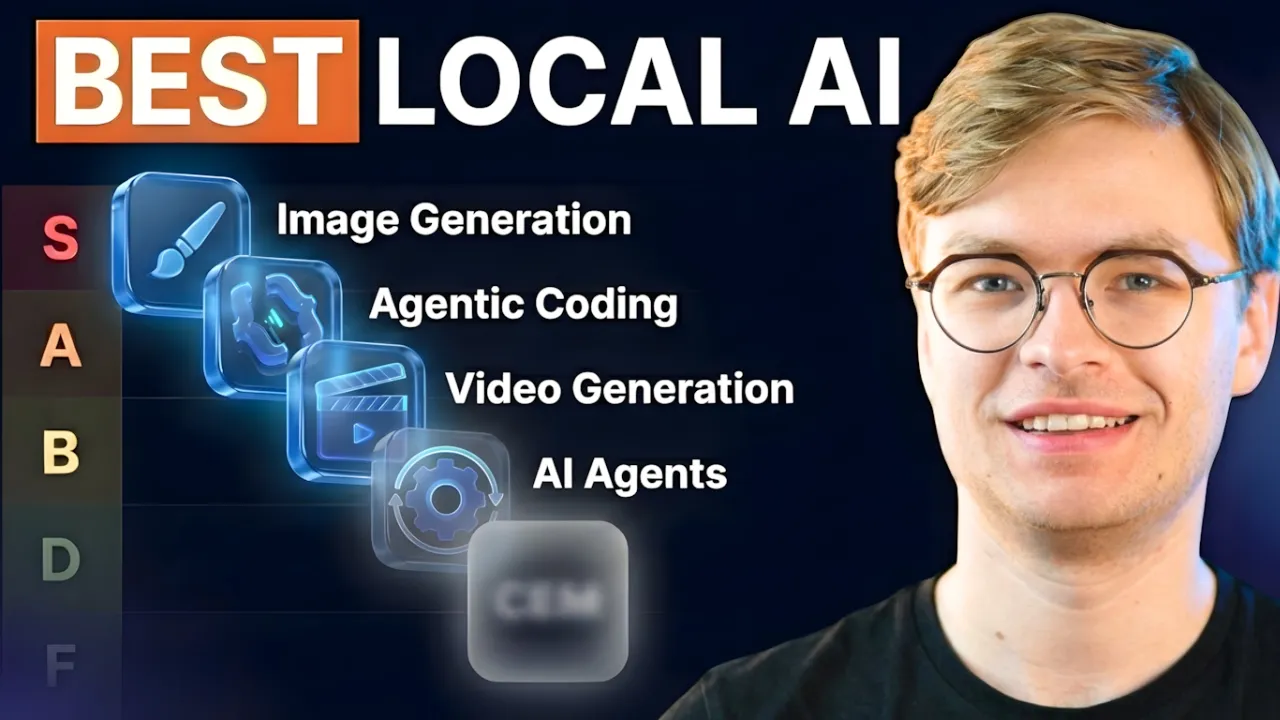
I covered the full local AI tier list across every major use case in my latest YouTube video, including code autocomplete, image generation, and voice agents. Watch the full breakdown here to see which local AI use cases are worth your time.
To go deeper on building real local AI systems alongside other engineers, join the AI Engineer community. We share what is working, what is hype, and how to build setups that hold up in production rather than just on a demo reel.