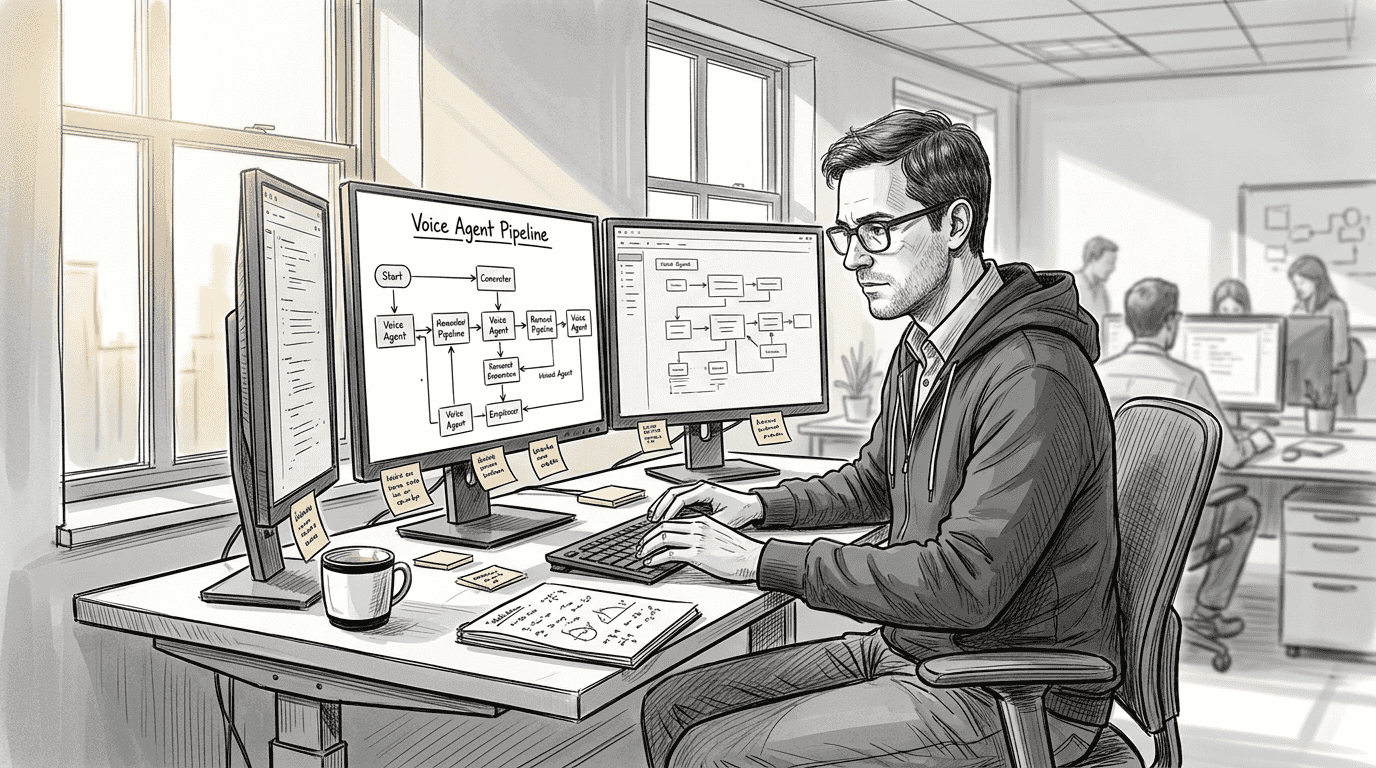
Voice agent architecture overview for AI engineers
Voice agent architecture overview for AI engineers
Voice agent latency under 800 milliseconds can make the difference between users hanging up frustrated and completing their call successfully. Yet most AI engineers focus purely on accuracy metrics while ignoring the architectural decisions that create lag. Voice agent systems combine speech recognition, language models, and speech synthesis in complex ways that each add milliseconds to response time. This guide breaks down cascade, fused, and speech-to-speech architectures with real latency benchmarks from 2026 providers, evaluation frameworks beyond simple accuracy scores, and practical optimization techniques you can apply immediately to production systems.
Table of Contents
- Understanding Voice Agent Architecture Fundamentals
- Comparing Cascade, Fused, And Speech-To-Speech Architectures
- Latency Benchmarks And Stt Provider Performance In 2026
- Evaluating Voice Agent Performance Beyond Latency And Accuracy
- Advance Your Ai Engineering Career With Expert Voice Agent Guidance
Key takeaways
| Point | Details |
|---|---|
| Latency threshold | Voice agents need under 800ms response time for natural conversation flow and user satisfaction |
| Architecture trade-offs | Cascade offers modularity at 400-1100ms, fused reduces latency with integrated components, speech-to-speech achieves 100-330ms |
| STT benchmarks | Leading providers range from 247ms to 495ms median latency with word error rates around 1-1.6% |
| Real-world metrics | Production evaluation requires percentile latency (P50, P95, P99), interruption rates, repetition failures, and sentiment analysis |
| Optimization paths | Streaming responses, intelligent caching, and provider selection on accuracy-latency frontier improve responsiveness |
Understanding voice agent architecture fundamentals
Voice agents orchestrate three core components that transform speech into intelligent responses and back into speech. Speech-to-text (ASR) systems convert audio into text transcripts. Language models process that text to understand intent and generate appropriate responses. Text-to-speech (TTS) engines synthesize the model’s text output into natural-sounding audio.
Each subsystem introduces processing delays that compound into total system latency. Classic ASR + LLM + TTS pipelines have baseline latency of 400-1100ms, depending on model choices and optimization techniques. Understanding these individual components helps you identify bottlenecks and make informed architectural decisions.
The pipeline flow creates dependencies where each stage must complete before the next begins in traditional cascade architectures. ASR waits for speech input, the LLM processes complete transcripts, and TTS generates audio only after receiving full text responses. This sequential processing fundamentally limits how fast the system can respond, though techniques like streaming and partial processing can reduce perceived latency.
Key architectural considerations include:
- Speech recognition accuracy and speed trade-offs across providers
- Language model size, capability, and inference time
- TTS voice quality, naturalness, and generation speed
- Network latency between distributed components
- Ability to handle user interruptions mid-response
Production AI appointment setting voice agent systems must balance these factors while maintaining conversation quality. The component choices you make directly impact whether users perceive your agent as responsive or frustratingly slow.
Comparing cascade, fused, and speech-to-speech architectures
Cascade architectures separate ASR, LLM, and TTS into distinct, independently optimized modules. Cascade-based architectures allow independent optimization of components like speech-to-text, large language models, and text-to-speech, enabling advanced LLM use and explicit safety guardrails. This modularity lets you swap providers, update models, and fine-tune each subsystem without rebuilding the entire pipeline.
The flexibility comes at a latency cost. Sequential processing means total response time equals the sum of all component delays plus network overhead. Typical cascade systems achieve 400-1100ms baseline latency before optimization. You gain control and customization but sacrifice raw speed.
Fused architectures consolidate speech recognition, reasoning, and generation into a single neural network like OpenAI’s Realtime model. Integration eliminates handoff delays between components and reduces overall system complexity. Deployment becomes simpler with fewer moving parts to coordinate and monitor.
Trade-offs include reduced control over individual subsystems and potential prosody challenges. You cannot easily swap the speech recognition engine or upgrade to a more capable language model independently. The unified model either works for your use case or requires complete replacement.
Speech-to-Speech models achieve lowest latency with perceived response start times of 100-330ms by directly transforming input speech to output speech. These end-to-end systems skip text intermediate representations entirely, preserving prosody and emotional tone naturally. The direct audio-to-audio transformation eliminates multiple conversion steps that add delay.
Architecture comparison:
| Architecture Type | Latency Range | Key Advantage | Primary Limitation |
|---|---|---|---|
| Cascade | 400-1100ms | Component modularity and LLM flexibility | Higher accumulated latency |
| Fused | 200-500ms | Simplified deployment and reduced handoffs | Limited component control |
| Speech-to-Speech | 100-330ms | Lowest latency with prosody preservation | Emerging technology with fewer options |
Pro Tip: Choose cascade architectures when you need advanced language model capabilities or frequent component updates. Select fused or speech-to-speech when latency is the primary constraint and you can accept less granular control.
For production systems running advanced language models locally, cascade architectures provide the flexibility to optimize inference separately from speech processing. The modular approach also simplifies debugging since you can isolate which component contributes most to latency spikes.
Latency benchmarks and STT provider performance in 2026
Real-world STT provider benchmarks reveal significant performance variations that directly impact voice agent responsiveness. Deepgram Nova 3 achieved 247ms median latency with 1.62% word error rate, representing the fastest option with acceptable accuracy. Soniox achieved 249ms median latency and 1.29% WER, offering slightly better accuracy at nearly identical speed.
Speechmatics achieved 495ms median latency and 1.07% WER, trading response time for improved transcription accuracy. This positions Speechmatics as a better choice for applications where accuracy matters more than instant response, such as medical or legal transcription use cases.
The accuracy-latency frontier helps you select providers that maximize both dimensions rather than accepting suboptimal performance on either metric. Providers clustered near the frontier deliver better overall value than those significantly slower or less accurate than alternatives.
2026 STT provider performance:
| Provider | Median Latency | Word Error Rate | Best For |
|---|---|---|---|
| Deepgram Nova 3 | 247ms | 1.62% | Speed-critical applications |
| Soniox | 249ms | 1.29% | Balanced speed and accuracy |
| Speechmatics | 495ms | 1.07% | Accuracy-priority use cases |
Optimization techniques beyond provider selection include:
- Streaming partial transcripts to begin LLM processing before complete utterances
- Caching common phrases and responses to skip repeated processing
- Pre-warming model inference pipelines to eliminate cold start delays
- Geographic distribution of services to minimize network latency
- Implementing voice activity detection to reduce unnecessary processing
Pro Tip: Monitor dialogue latency percentiles (P50, P95, P99) in production environments rather than just median values. P95 and P99 latency spikes often reveal infrastructure bottlenecks and edge cases that median statistics hide but users experience as frustrating delays.
Applying AI caching strategies to frequently requested information can reduce effective latency by 50-80% for common queries. Intelligent caching works especially well for appointment setting, customer service FAQs, and other domains with predictable conversation patterns.
Evaluating voice agent performance beyond latency and accuracy
Text-focused LLM evaluations miss critical real-world failures that users experience in voice conversations. Interruption handling, silence management, and prosody naturalness affect user satisfaction as much as response correctness. Traditional benchmarks that measure only accuracy on static datasets fail to capture these interaction dynamics.
Cekura benchmarks voice agents across the entire stack including speech recognition, reasoning, dialogue management, TTS, and voice delivery under realistic conditions. This comprehensive approach tests whether agents inappropriately interrupt users, handle user interruptions gracefully, avoid repetition, manage silence effectively, and maintain stable performance under infrastructure stress.
Production voice agent failures often stem from the complex interaction between components rather than individual subsystem errors. An agent might transcribe speech perfectly but interrupt the user mid-sentence due to aggressive voice activity detection, creating terrible user experience despite high technical accuracy.
Production latency benchmarks from 4M+ calls show P50 under 1.5 seconds, P95 under 3.5 seconds, and P99 under 8 seconds. These percentile metrics provide more complete performance pictures than median-only reporting. P99 latency reveals worst-case scenarios that frustrate users even when typical responses arrive quickly.
Essential evaluation metrics for production voice agents:
- Latency percentiles (P50, P95, P99) across different conversation stages
- User interruption success rate when changing topics or correcting agents
- Agent interruption frequency and appropriateness during user speech
- Repetition and loop detection for stuck conversation states
- Silence handling and appropriate pause management
- Sentiment analysis across conversation trajectory
- Tool call success rates under realistic scenarios
- Customer satisfaction scores (CSAT) and net promoter scores
- Call completion rates and abandonment patterns
Pro Tip: Integrate real-world benchmarking early in your development cycle rather than as a final validation step. Testing against realistic scenarios throughout development catches interaction issues before they become architectural problems requiring major refactoring.
Comprehensive evaluation extends beyond technical metrics to business outcomes. Track how voice agent performance correlates with conversion rates, customer retention, support ticket reduction, and other operational KPIs. Technical excellence means nothing if the system fails to deliver business value.
Successful AI agent implementation use cases demonstrate clear connections between technical performance improvements and measurable business impact. Frame your optimization work around outcomes that matter to stakeholders, not just impressive technical specifications.
Advance your AI engineering career with expert voice agent guidance
Building production voice agents requires practical implementation knowledge that goes beyond academic understanding. You need real architectural patterns, proven optimization techniques, and evaluation frameworks that actually predict user satisfaction. The gap between knowing concepts and shipping systems is where careers accelerate or stall.
Want to learn exactly how to build voice agents that respond fast enough to keep users engaged? Join the AI Engineering community where I share detailed tutorials, code examples, and work directly with engineers building production AI systems.
Inside the community, you’ll find practical voice agent strategies that actually work in production, plus direct access to ask questions and get feedback on your implementations.
Frequently asked questions
What are the main challenges in optimizing voice agent latency?
Managing processing delays across ASR, LLMs, and TTS while maintaining accuracy creates the primary optimization challenge. Network latency between distributed components and effective interruption handling add complexity. Optimization requires balancing speed against accuracy across all integrated systems rather than optimizing components in isolation.
How do cascade and fused architectures differ in practical applications?
Cascade architectures offer modularity for easier customization, allowing you to use advanced LLMs and swap components independently, but typically achieve 400-1100ms latency. Fused architectures merge components into unified models for faster response (200-500ms) and simpler deployment but provide less granular control over individual subsystems. Choose based on whether you prioritize flexibility or raw speed.
What evaluation metrics best reflect real-world voice agent performance?
Latency percentiles (P50, P95, P99) reveal performance consistency better than median values alone. User interruption handling, agent interruption frequency, repetition rates, and silence management capture interaction quality. Sentiment analysis, call completion rates, and CSAT scores connect technical performance to user satisfaction. Realistic scenario benchmarking tools like Cekura test the entire stack under production conditions.
How does speech-to-speech architecture achieve such low latency?
Speech-to-speech models transform input audio directly to output audio without converting to text intermediates. Skipping text transcription and text-to-speech conversion eliminates multiple processing steps that each add delay. The direct audio transformation achieves 100-330ms perceived latency while naturally preserving prosody and emotional tone that text-based pipelines struggle to maintain.
Recommended
- AI agent terminology explained for engineers in 2026
- AI Voice Agents for Travel and Hospitality
- AI Agent Development Practical Guide for Engineers
- How to Build AI Agents - Practical Guide for Developers