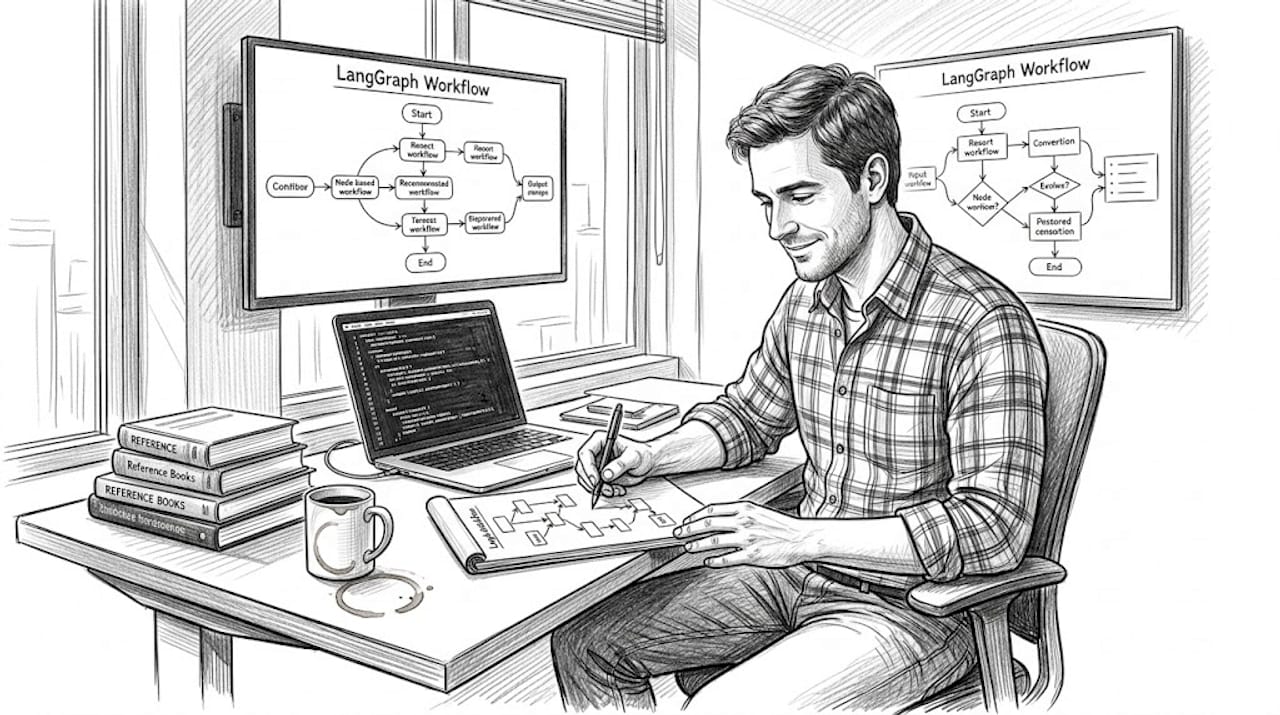
Agentic AI examples practical tools for engineers
Agentic AI examples practical tools for engineers
TL;DR:
- Tool quality, test coverage, and hybrid guardrails are critical for reliable production agentic AI.
- Frameworks like LangGraph, CrewAI, and AutoGen differ in workflow design and flexibility.
- Focusing on edge case handling and rigorous validation is more important than agent complexity alone.
The agentic AI landscape has exploded with frameworks, each promising to be the one you need to ship production systems. LangGraph, CrewAI, Microsoft AutoGen, and a growing list of alternatives all claim to solve multi-agent orchestration. But choosing the wrong tool doesn’t just slow you down; it creates technical debt that’s painful to unwind six months later. This article cuts through the noise by walking you through concrete examples of each major framework, comparing them on criteria that actually matter in production, and giving you the decision-making lens to pick the right tool for your specific use case.
Table of Contents
- Selection criteria for agentic AI frameworks
- LangGraph: Graph-based stateful workflows
- CrewAI: Role-based multi-agent orchestration
- Microsoft AutoGen: Conversational multi-agent systems
- Edge cases, testing, and hybrid strategies
- What most guides miss about agentic AI in production
- Advance your agentic AI engineering expertise
- Frequently asked questions
Key Takeaways
| Point | Details |
|---|---|
| Evaluate with clear criteria | Assess agentic AI frameworks using memory, delegation, context, and edge case handling as core decision factors. |
| Explore LangGraph and CrewAI | LangGraph offers stateful workflows; CrewAI delivers role-based orchestration for advanced multi-agent systems. |
| Prioritize robust tool use | Production success relies more on robust tool selection and precise testing than agent sophistication. |
| Hybrid approaches win in edge cases | Combining symbolic and neural paradigms improves reliability and resolves rare failures effectively. |
Selection criteria for agentic AI frameworks
With selection challenges defined, let’s dive into the core evaluation criteria every engineer should use before committing to a framework.
Not all agentic AI frameworks are built the same, and the differences aren’t just cosmetic. When you’re evaluating options for a real system, you need a structured lens. Here are the criteria that matter most:
- Memory persistence: Can the agent retain state across sessions, or does it start fresh every run?
- Task delegation: Does the framework support hierarchical or sequential task handoff between agents?
- Context management: How does the system handle long conversations, large tool outputs, or token limits?
- Safety features: Are there guardrails for infinite loops, adversarial inputs, or runaway tool calls?
- Edge case resilience: What happens when a tool fails, returns unexpected output, or the agent gets stuck?
- Tool integration: How cleanly does the framework connect to external APIs, databases, and custom functions?
Understanding the mechanics underneath these criteria matters. Core agentic mechanics like the PRAO loop (Perceive, Reason, Act, Observe) and ReAct reasoning are foundational for robust decision-making, safety, and tool integration. The PRAO loop describes how an agent cycles through environmental perception, internal reasoning, action execution, and result observation. ReAct extends this by interleaving reasoning traces with action steps, making agent behavior more interpretable and debuggable.
For a deeper look at how these mechanics play out in real systems, the practical agentic AI guide on this blog covers implementation patterns worth bookmarking. And if you want to understand why so many agentic projects stall before reaching users, the AI failure analysis breakdown is eye-opening.
One underrated insight: training tools beats training agents in most production scenarios. Engineers often over-invest in agent sophistication while neglecting the quality of the tools those agents call.
Pro Tip: Before evaluating any framework, map out the tools your agent needs to call and the failure modes for each. A framework that handles tool errors gracefully is worth more than one with flashy orchestration features.
LangGraph: Graph-based stateful workflows
Now, let’s look at a concrete example. LangGraph focuses on graph-based, stateful workflow design, and it’s one of the most mature options available today.
LangGraph is a leading open-source framework for stateful, multi-actor agentic AI applications, built around graph nodes, conditional routing, memory persistence, and human-in-the-loop support. The core mental model is simple: your workflow is a directed graph where nodes represent actions or agent steps, and edges define the routing logic between them.
Conditional edges are where LangGraph gets powerful. You can route to different nodes based on agent output, tool results, or custom logic. This makes it straightforward to build systems where an agent decides whether to call a search tool, escalate to a human reviewer, or loop back for another reasoning pass.
Key strengths of LangGraph include:
- Persistent memory: State is carried across graph nodes, enabling long-running workflows without losing context
- Human-in-the-loop: Built-in support for pausing execution and waiting for human input before continuing
- Context summarization: Handles long conversations by summarizing earlier context to stay within token limits
- Modular design: Nodes are reusable, making it easy to compose complex pipelines from simpler components
- Strong LangChain integration: Works natively with LangChain’s tool and model ecosystem
| Feature | LangGraph | Traditional agent orchestration |
|---|---|---|
| State management | Persistent across nodes | Typically stateless per run |
| Routing logic | Conditional graph edges | Linear or rule-based |
| Human-in-the-loop | Native support | Usually bolted on |
| Debugging | Visual graph tracing | Log-based only |
| Flexibility | High, composable nodes | Limited by framework structure |
For engineers already working with LangChain, the guide on using LangGraph with LangChain is a practical starting point. If you want to understand what’s happening under the hood before you build, understanding agentic mechanics gives you the right foundation. You can also find a detailed walkthrough on building AI agents with LangGraph for hands-on implementation patterns.
Pro Tip: Use conditional routing to build sophisticated agent collaboration patterns. Instead of a single agent trying to do everything, route specialized sub-agents based on task type. This keeps each node focused and makes the system easier to test.
CrewAI: Role-based multi-agent orchestration
With LangGraph’s workflow in mind, see how CrewAI approaches complexity using roles and delegation.
CrewAI enables structured, role-based multi-agent crews with hierarchical delegation. Agents are defined by role, goal, and backstory, and the framework supports both sequential and hierarchical execution modes. The role-based model is intuitive: you define a Researcher agent, a Writer agent, and a Reviewer agent, then let CrewAI manage how they hand off tasks.
This structure maps naturally to how enterprise teams actually work. Instead of one monolithic agent trying to handle research, synthesis, and output formatting, you get specialized agents with clear responsibilities. The backstory mechanism is surprisingly useful; it shapes how each agent interprets its task without requiring complex prompt engineering.
CrewAI agent role types and their advantages:
- Researcher: Gathers and synthesizes information from external sources
- Planner: Breaks down complex goals into executable sub-tasks
- Executor: Carries out specific actions or tool calls
- Reviewer: Validates output quality before passing results downstream
- Coordinator: Manages task flow and resolves conflicts between agents
| Dimension | CrewAI | LangGraph |
|---|---|---|
| Orchestration model | Role-based crews | Graph-based workflows |
| Delegation style | Hierarchical or sequential | Conditional routing |
| Setup complexity | Low to medium | Medium to high |
| Best for | Team-like collaboration | Complex stateful pipelines |
| Enterprise fit | Strong | Strong with more engineering effort |
For engineers building systems that mirror team workflows, the agentic AI orchestration guide covers orchestration patterns that apply directly to CrewAI deployments. For a broader view of autonomous systems design, the autonomous systems engineering guide is worth reading alongside this. A detailed CrewAI framework comparison across major agentic tools is also available if you want a side-by-side view.
CrewAI’s biggest advantage is speed of setup for team-structured problems. Its biggest limitation is flexibility: complex conditional logic that LangGraph handles naturally requires more workarounds in CrewAI.
Microsoft AutoGen: Conversational multi-agent systems
Now compare with Microsoft AutoGen, which focuses on conversational orchestration and code execution.
Microsoft AutoGen specializes in conversational multi-agent systems with UserProxyAgent for code execution, RoundRobinGroupChat for coordination, and excels in dynamic negotiation between agents. The core idea is that agents communicate through structured conversation turns, and the system manages who speaks when.
What makes AutoGen stand out is its built-in code execution pipeline. An agent can write code, pass it to a UserProxyAgent for execution, receive the output, and iterate. This loop is powerful for data analysis, automated testing, and any task where code generation and verification need to happen together.
AutoGen’s coordination and safety toolkit includes:
- UserProxyAgent: Executes code in a sandboxed environment and returns results to the agent
- RoundRobinGroupChat: Manages turn-taking across multiple agents in a structured conversation
- Dynamic negotiation: Agents can propose, challenge, and refine outputs through dialogue
- Termination conditions: Configurable rules to stop agent loops when goals are met or errors occur
- Safety layers: Built-in checks to prevent runaway execution and handle tool failures
“AutoGen’s conversational model enables agents to negotiate solutions iteratively, making it particularly effective for tasks where the right answer emerges through dialogue rather than a single pass.”
Edge case handling is an area where AutoGen requires careful configuration. Context overflow, infinite negotiation loops, and tool hallucinations are real risks in conversational systems. The guide on using tool calling and context management covers the patterns that keep these systems stable in production.
AutoGen is the right choice when your task genuinely benefits from agents debating and refining outputs. For simpler workflows, the conversational overhead adds latency without much benefit.
Edge cases, testing, and hybrid strategies
With individual frameworks detailed, let’s address edge cases and strategies for resilient agentic AI engineering.
Major edge cases include context overflow, tool hallucinations, infinite loops, and adversarial environments. Hybrid symbolic and neural approaches tend to outperform pure neural solutions when handling these failures. This is not a minor footnote; it’s one of the most important architectural decisions you’ll make.
The benchmark numbers are sobering. SWE-bench resolution rates sit at 40 to 50% for top agents, while WebArena task completion drops to 10 to 20%. Real-world performance is lower still. These gaps exist largely because of edge cases that test suites don’t cover.
Common agentic failure modes to plan for:
- Context overflow: Agent loses critical information as conversation grows beyond token limits
- Tool hallucinations: Agent calls tools with incorrect parameters or invents tool outputs
- Infinite loops: Agent cycles through the same reasoning steps without making progress
- Adversarial inputs: Malicious or malformed inputs cause unexpected agent behavior
- Cascade failures: One agent’s bad output corrupts downstream agents in a pipeline
The hybrid symbolic and neural approaches research shows that combining rule-based guardrails with neural reasoning significantly improves edge case performance. Symbolic rules handle known failure modes deterministically, while neural components handle ambiguity and generalization.
For a grounded look at where AI coding tools fail under pressure, the coding tool failure research is directly relevant. And for the context management patterns that prevent overflow failures, context engineering best practices covers the techniques that work.
Pro Tip: Train your tools, not just your agents. A well-defined tool with clear input validation and error handling is worth more than a sophisticated agent reasoning loop. Invest in prompt and test coverage for every tool your agent calls.
What most guides miss about agentic AI in production
Bringing it all together, here’s what typical agentic AI guides overlook about actually reaching robust production.
Most framework comparisons focus on features and syntax. What they miss is the operational reality: production agentic AI lives or dies on tool quality and test coverage, not agent sophistication. You can have the most elegant graph-based workflow in LangGraph, but if your tools return inconsistent outputs, your agent will hallucinate its way to failure.
The uncomfortable truth is that prompts and triggers are under-tested, with some estimates suggesting as little as 1% test coverage for agent trigger conditions. Engineers spend weeks tuning agent reasoning while shipping tools with zero edge case tests.
Hybrid symbolic and neural strategies are not academic exercises. They are the practical answer to the gap between benchmark performance and production reliability. The AI intelligence gap benchmarks illustrate just how wide that gap remains.
Don’t chase agent complexity. Invest in test coverage, rigorous tool validation, and hybrid guardrails. That’s where production reliability actually comes from.
Advance your agentic AI engineering expertise
Want to learn exactly how to build production agentic AI systems that handle real-world edge cases? Join the AI Engineering community where I share detailed tutorials, code examples, and work directly with engineers building multi-agent systems.
Inside the community, you’ll find practical orchestration strategies that actually work in production, plus direct access to ask questions and get feedback on your agentic implementations.
Frequently asked questions
What are agentic AI systems?
Agentic AI systems are autonomous agents that perceive, reason, act, and observe in dynamic environments using structured workflows and delegated tasks. The PRAO loop (Perceive, Reason, Act, Observe) is the core mechanic that drives this cycle.
Which agentic AI framework is best for role-based delegation?
CrewAI excels in role-based multi-agent orchestration, allowing engineers to define agent goals, backstories, and leverage structured task delegation. CrewAI’s role-based model supports both sequential and hierarchical execution modes.
How do agentic AI tools handle context overflow and tool hallucinations?
Stateful frameworks like LangGraph and hybrid strategies can summarize context and use budget exhaustion techniques to minimize overflow and tool hallucinations. Summarization and budget exhaustion are the two most practical mitigations available today.
Do production AI systems prefer symbolic, neural, or hybrid agentic approaches?
Production agentic AI systems increasingly favor hybrid symbolic-neural paradigms for reliability and edge case performance. Hybrid symbolic and neural approaches outperform pure neural solutions in handling real-world failure modes.
Recommended
- Agentic AI A Practical Guide for AI Engineers
- Agentic Coding - Transforming AI Engineering Skills
- Agentic AI and Autonomous Systems Engineering Guide
- How AI Agents Actually Work Under the Hood
- Welcome3 AI Setup Guide